Impact Goals
D-Lab founder Amy Smith has said, “Impact is not just the product of innovation; it is the process of innovation.” In that spirit, D-Lab drives toward two goals. The first is better solutions: we strive toward a world where more effective products and services reach the users who need them, improving their incomes and their quality of life. The second is better development: we dream that a more inclusive approach to tackling poverty challenges becomes the rule and not the exception.
Pathways
We work towards these goals in three ways: we design, we teach, and we influence. In collaboration with innovators, entrepreneurs, and end-users, we develop and support solutions that can be delivered at scale. Through our classes and global workshops, we teach inclusive design and development to people at MIT and around the world. And by developing new findings and approaches, and sharing them through global communities of practice, we can influence others to adopt effective methods and inclusive practices.
Touchstone
All of our strategies hinge on a central point: the learning and transformation of individuals. Across our work, people come away with new skills, knowledge, mindsets, and relationships. Whether we are designing a product, teaching a class, conducting a study, or convening a summit, people and their learning are at the center.
3 Issues in this Publication (Showing 1 - 3)
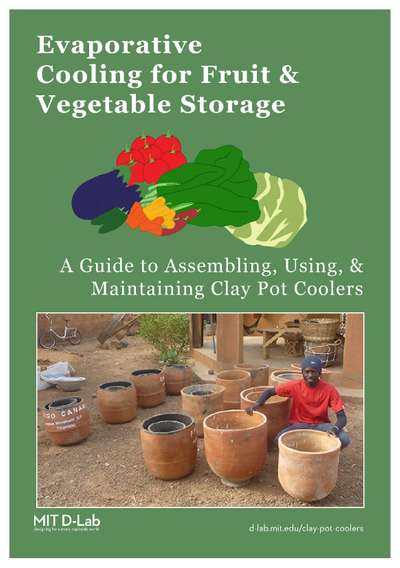
A Guide to Assembling, Using, & Maintaining Clay Pot Coolers
Clay pot coolers are designed to cool air through the evaporation of water, providing a stable environment to store most fruits & vegetables.
- Wet sand placed between a larger outer pot, dish, or basin, keeps the fruits and vegetables inside the inner chamber cool.
- A jute bag or other absorbent cloth material placed over the opening protects its contents.
Participation for Humanitarian Innovation Toolkit
Inclusive participation presents numerous benefits for people affected by crises, and different participatory practices yield different outcomes. However, meaningful participation requires conditions and enabling factors that are often difficult to foster in complex humanitarian contexts, and trade-offs are often necessary.
The Opportunity Adviser examines the benefits of participation alongside the barriers that may be present. This comparison helps implementing stakeholders to consider the desired outcomes of their intervention, and design the appropriate type of participatory events to engage other stakeholders meaningfully and successfully, and identify better solutions to humanitarian challenges.
Evaporative Cooling Best Practices - 20 មករា 2018
Producing and using evaporative cooling chambers and clay pot coolers
Eric Verploegen Peter Rinker Kukom Edoh Ognakossan June 2018
When affordable and effective post-harvest storage solutions are in short supply, populations will often experience vegetable spoilage, loss of income, lack of access to nutritious foods, and large amounts of time spent purchasing vegetables, particularly in rural communities. Devices such as evaporative cooling chambers (ECCs) and clay pot coolers are simple and inexpensive ways to keep vegetables fresh without the use of electricity. These devices function according to a basic principle called “evaporative cooling,” where the evaporation of water from a surface removes heat, creating a cooling effect. Evaporative cooling can improve vegetable storage shelf life by providing:
- A stable storage environment with low temperature and high humidity, which reduces the rate of respiration and water loss and spoilage in most vegetables.
- Protection from animals and insects that contaminate and eat the vegetables
The improved storage environment can have positive impacts including reduced post-harvest losses, less time spent traveling to the market, monetary savings, and increased availability of vegetables for consumption. These devices can also have farther-reaching impacts, particularly on women, who often make pottery and could benefit economically from producing clay pots with local materials, as well as selling fruits and vegetables in more flexible markets that have access to evaporative cooling technology.