The University of Florida (UF) provides numerous plant information PDFs through its IFAS Extension and the Florida-Friendly Landscaping program. Key publications include the Florida-Friendly Landscaping™ Guide to Plant Selection & Landscape Design and guides on low-maintenance and regionally specific plants, such as the one for south Florida. Other PDFs cover specific topics like vegetable production, tree fact sheets on planting and pruning, and invasive species information.
45 Issues in this Publication (Showing issues - 1) Previous
Leek Cultivation Guide for Florida
HS1388
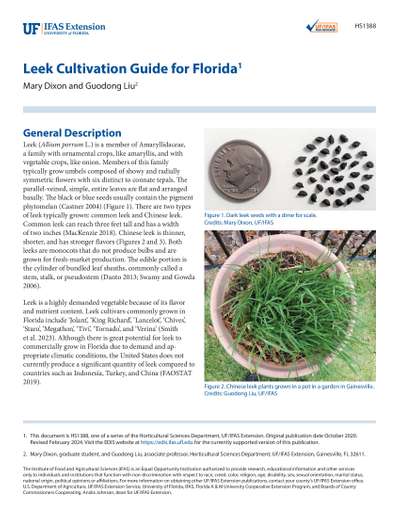
Leek (Allium porrum L.) is a member of Amaryllidaceae, a family with ornamental crops, like amaryllis, and with vegetable crops, like onion. Members of this family typically grow umbels composed of showy and radially symmetric flowers with six distinct to connate tepals. The parallel-veined, simple, entire leaves are flat and arranged basally. The black or blue seeds usually contain the pigment phytomelan (Castner 2004) (Figure 1). There are two types of leek typically grown: common leek and Chinese leek. Common leek can reach three feet tall and has a width of two inches (MacKenzie 2018). Chinese leek is thinner, shorter, and has stronger flavors (Figures 2 and 3). Both leeks are monocots that do not produce bulbs and are grown for fresh-market production. The edible portion is the cylinder of bundled leaf sheaths, commonly called a stem, stalk, or pseudostem (Danto 2013; Swamy and Gowda 2006).
1. This document is HS1388, one of a series of the Horticultural Sciences Department, UF/IFAS Extension. Original publication date October 2020. Revised February 2024. Visit the EDIS website at https://edis.ifas.ufl.edu for the currently supported version of this publication.
2. Mary Dixon, graduate student, and Guodong Liu, associate professor, Horticultural Sciences Department; UF/IFAS Extension, Gainesville, FL 32611.
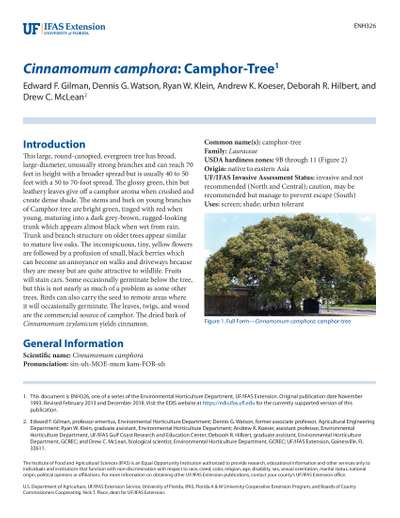
Cinnamomum camphora: Camphor-Tree1
ENH326
Scientific name: Cinnamomum camphora
Pronunciation: sin-uh-MOE-mum kam-FOR-uh
Common name(s): camphor-tree
Family: Lauraceae
USDA hardiness zones: 9B through 11 (Figure 2)
Origin: native to eastern Asia UF/IFAS
Invasive Assessment Status: invasive and not recommended (North and Central); caution, may be recommended but manage to prevent escape (South)
Uses: screen; shade; urban tolerant
1. This document is ENH326, one of a series of the Environmental Horticulture Department, UF/IFAS Extension. Original publication date November 1993. Revised February 2013 and December 2018. Visit the EDIS website at https://edis.ifas.ufl.edu for the currently supported version of this publication.
2. Edward F. Gilman, professor emeritus, Environmental Horticulture Department; Dennis G. Watson, former associate professor, Agricultural Engineering Department; Ryan W. Klein, graduate assistant, Environmental Horticulture Department; Andrew K. Koeser, assistant professor, Environmental Horticulture Department, UF/IFAS Gulf Coast Research and Education Center; Deborah R. Hilbert, graduate assistant, Environmental Horticulture Department, GCREC; and Drew C. McLean, biological scientist, Environmental Horticulture Department, GCREC; UF/IFAS Extension, Gainesville, FL 32611.
Southern Highbush Blueberry Cultivars from the University of Florida
HS1245
Blueberries are native to eastern North America and are one of the few crop plants that originated here. The woods and swamps of Florida are populated with at least eight wild blueberry species, including highbush blueberry (Vaccinium corymbosum), rabbiteye blueberry (Vaccinium virgatum), and evergreen blueberry (Vaccinium darrowii). Wild blueberries are present nearly everywhere in Florida, except in areas where soil pH is above 6.0. This publication provides historical background on southern highbush blueberries (SHB) and information on specific UF/IFAS cultivars that can be a helpful resource for SHB growers. The intended audience is primarily Florida commercial blueberry growers but also commercial growers in other locations growing UF/IFAS cultivars. Table 1 provides information on plant and berry characteristics for selected cultivars.
1. This document is HS1245, one of a series of the Department of Horticultural Sciences, UF/IFAS Extension. Original publication date March 2014. Revised February 2019, September 2022, and October 2024. Visit the EDIS website at https://edis.ifas.ufl.edu for the currently supported version of this publication. J. W. Olmstead and G. K. England contributed to earlier versions of this publication.
2. D. A. Phillips, blueberry Extension coordinator, UF/IFAS Gulf Coast Research and Education Center; J. G. Williamson, professor; P. M. Lyrene, professor emeritus; and P. R. Munoz, associate professor, Department of Horticultural Sciences; UF/IFAS Extension, Gainesville, FL 32611.
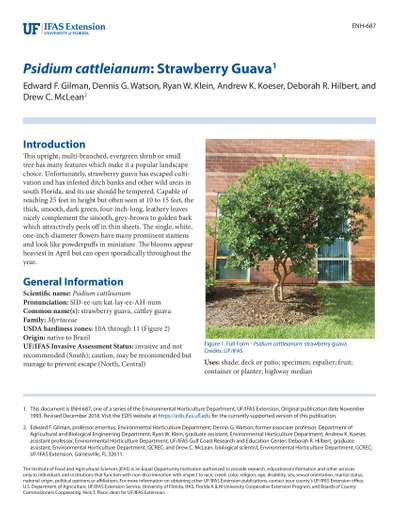
Psidium cattleianum: Strawberry Guava1
ENH-687
Scientific name: Psidium cattleianum
Pronunciation: SID-ee-um kat-lay-ee-AH-num
Common name(s): strawberry guava, cattley guava
Family: Myrtaceae
USDA hardiness zones: 10A through 11 (Figure 2)
Origin: native to Brazil UF/IFAS Invasive
Assessment Status: invasive and not recommended (South); caution, may be recommended but manage to prevent escape (North, Central)
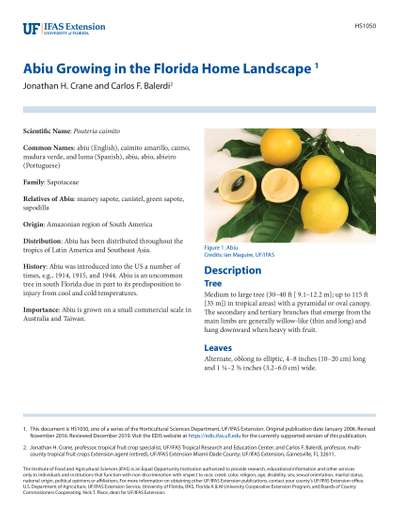
Abiu Growing in the Florida Home Landscape
HS1050
Scientific Name: Pouteria caimito
Common Names: abiu (English), caimito amarillo, caimo, madura verde, and luma (Spanish), abiu, abio, abieiro (Portuguese)
Family: Sapotaceae
Relatives of Abiu: mamey sapote, canistel, green sapote, sapodilla
Origin: Amazonian region of South America
Distribution: Abiu has been distributed throughout the tropics of Latin America and Southeast Asia.
1. This document is HS1050, one of a series of the Horticultural Sciences Department, UF/IFAS Extension. Original publication date January 2006. Revised November 2016. Reviewed December 2019. Visit the EDIS website at https://edis.ifas.ufl.edu for the currently supported version of this publication.
2. Jonathan H. Crane, professor, tropical fruit crop specialist, UF/IFAS Tropical Research and Education Center; and Carlos F. Balerdi, professor, multicounty tropical fruit crops Extension agent (retired), UF/IFAS Extension Miami-Dade County; UF/IFAS Extension, Gainesville, FL 32611.