University of Florida Plant Information Leek Cultivation Guide for Florida
HS1388
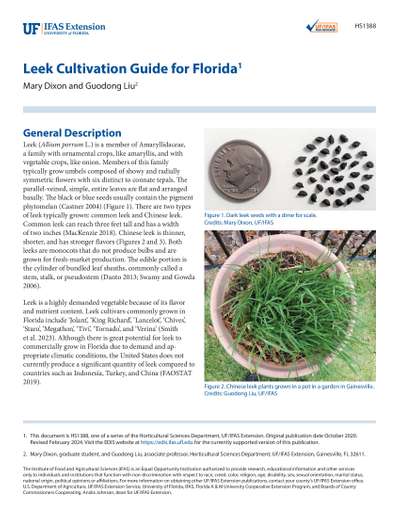
Leek (Allium porrum L.) is a member of Amaryllidaceae, a family with ornamental crops, like amaryllis, and with vegetable crops, like onion. Members of this family typically grow umbels composed of showy and radially symmetric flowers with six distinct to connate tepals. The parallel-veined, simple, entire leaves are flat and arranged basally. The black or blue seeds usually contain the pigment phytomelan (Castner 2004) (Figure 1). There are two types of leek typically grown: common leek and Chinese leek. Common leek can reach three feet tall and has a width of two inches (MacKenzie 2018). Chinese leek is thinner, shorter, and has stronger flavors (Figures 2 and 3). Both leeks are monocots that do not produce bulbs and are grown for fresh-market production. The edible portion is the cylinder of bundled leaf sheaths, commonly called a stem, stalk, or pseudostem (Danto 2013; Swamy and Gowda 2006).
1. This document is HS1388, one of a series of the Horticultural Sciences Department, UF/IFAS Extension. Original publication date October 2020. Revised February 2024. Visit the EDIS website at https://edis.ifas.ufl.edu for the currently supported version of this publication.
2. Mary Dixon, graduate student, and Guodong Liu, associate professor, Horticultural Sciences Department; UF/IFAS Extension, Gainesville, FL 32611.