University of Florida Plant Information Cashew Apple Fruit Growing in the Florida Home Landscape
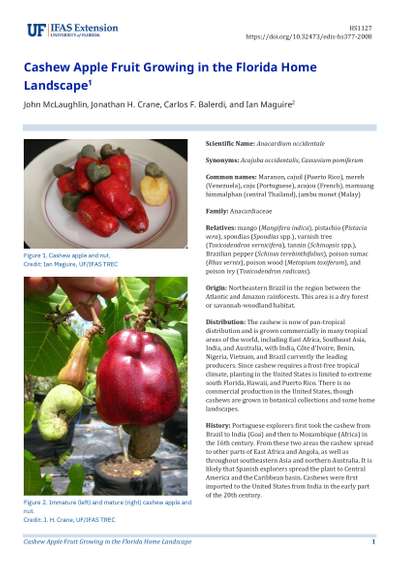
Scientific Name: Anacardium occidentale
Synonyms: Acajuba occidentalis, Cassuvium pomiferum
(Venezuela), caju (Portuguese), acajou (French), mamuang himmalphan (central Thailand), jambu monet (Malay)
Relatives: mango (Mangifera indica), pistachio (Pistacia vera), spondias (Spondias spp.), varnish tree (Toxicodendron vernicifera), tannin (Schinopsis spp.), Brazilian pepper (Schinus terebinthifolius), poison sumac (Rhus vernix), poison wood (Metopium toxiferum), and poison ivy (Toxicodendron radicans).
rigin: Northeastern Brazil in the region between the Atlantic and Amazon rainforests. This area is a dry forest or savannah-woodland habitat.
Distribution: The cashew is now of pan-tropical distribution and is grown commercially in many tropical areas of the world, including East Africa, Southeast Asia, India, and Australia, with India, Côte d'Ivoire, Benin, Nigeria, Vietnam, and Brazil currently the leading producers. Since cashew requires a frost-free tropical climate, planting in the United States is limited to extreme south Florida, Hawaii, and Puerto Rico. There is no commercial production in the United States, though cashews are grown in botanical collections and some home landscapes. History: Portuguese explorers first took the cashew from Brazil to India (Goa) and then to Mozambique (Africa) in the 16th century. From these two areas the cashew spread to other parts of East Africa and Angola, as well as throughout southeastern Asia and northern Australia. It is likely that Spanish explorers spread the plant to Central America and the Caribbean basin. Cashews were first imported to the United States from India in the early part of the 20th century.