University of Florida Plant Information Canistel Growing in the Florida Home Landscape
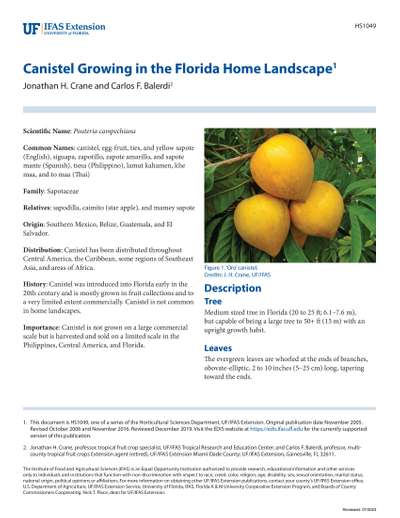
Scientific Name: Pouteria campechiana
Common Names: canistel, egg-fruit, ties, and yellow sapote (English), siguapa, zapotillo, zapote amarillo, and sapote mante (Spanish), tiesa (Philippino), lamut kahamen, khe maa, and to maa (Thai)
Family: Sapotaceae Relatives: sapodilla, caimito (star apple), and mamey sapote
Origin: Southern Mexico, Belize, Guatemala, and El Salvador.
Distribution: Canistel has been distributed throughout Central America, the Caribbean, some regions of Southeast Asia, and areas of Africa.
History: Canistel was introduced into Florida early in the 20th century and is mostly grown in fruit collections and to a very limited extent commercially. Canistel is not common in home landscapes.
Importance: Canistel is not grown on a large commercial scale but is harvested and sold on a limited scale in the Philippines, Central America, and Florida.
1. This document is HS1049, one of a series of the Horticultural Sciences Department, UF/IFAS Extension. Original publication date November 2005. Revised October 2006 and November 2016. Reviewed December 2019. Visit the EDIS website at https://edis.ifas.ufl.edu for the currently supported version of this publication.
2. Jonathan H. Crane, professor, tropical fruit crop specialist, UF/IFAS Tropical Research and Education Center; and Carlos F. Balerdi, professor, multicounty tropical fruit crops Extension agent (retired), UF/IFAS Extension Miami-Dade County; UF/IFAS Extension, Gainesville, FL 32611.