The University of Florida (UF) provides numerous plant information PDFs through its IFAS Extension and the Florida-Friendly Landscaping program. Key publications include the Florida-Friendly Landscaping™ Guide to Plant Selection & Landscape Design and guides on low-maintenance and regionally specific plants, such as the one for south Florida. Other PDFs cover specific topics like vegetable production, tree fact sheets on planting and pruning, and invasive species information.
56 Issues in this Publication (Showing issues - 1) Previous
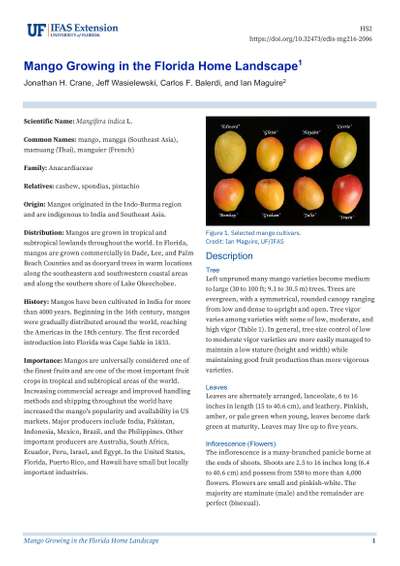
Mango Growing in the Florida Home Landscape
HS2
Family: Anacardiaceae Relatives: cashew, spondias, pistachio
Origin: Mangos originated in the Indo-Burma region and are indigenous to India and Southeast Asia.
Distribution: Mangos are grown in tropical and subtropical lowlands throughout the world. In Florida, mangos are grown commercially in Dade, Lee, and Palm Beach Counties and as dooryard trees in warm locations along the southeastern and southwestern coastal areas and along the southern shore of Lake Okeechobee.
History: Mangos have been cultivated in India for more than 4000 years. Beginning in the 16th century, mangos were gradually distributed around the world, reaching the Americas in the 18th century. The first recorded introduction into Florida was Cape Sable in 1833.
Importance: Mangos are universally considered one of the finest fruits and are one of the most important fruit crops in tropical and subtropical areas of the world. Increasing commercial acreage and improved handling methods and shipping throughout the world have increased the mango's popularity and availability in US markets. Major producers include India, Pakistan, Indonesia, Mexico, Brazil, and the Philippines. Other important producers are Australia, South Africa, Ecuador, Peru, Israel, and Egypt. In the United States, Florida, Puerto Rico, and Hawaii have small but locally important industries.
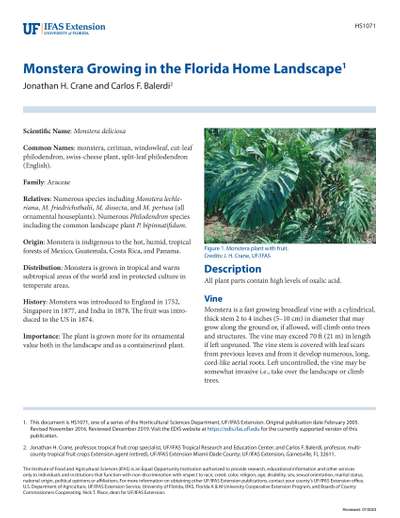
Monstera Growing in the Florida Home Landscape1
HS1071
Scientific Name: Monstera deliciosa Common Names: monstera, ceriman, windowleaf, cut-leaf philodendron, swiss-cheese plant, split-leaf philodendron (English).
Family: Araceae Relatives: Numerous species including Monstera lechleriana, M. friedrichsthalii, M. dissecta, and M. pertusa (all ornamental houseplants). Numerous Philodendron species including the common landscape plant P. bipinnatifidum.
Origin: Monstera is indigenous to the hot, humid, tropical forests of Mexico, Guatemala, Costa Rica, and Panama. Distribution: Monstera is grown in tropical and warm subtropical areas of the world and in protected culture in temperate areas.
History: Monstera was introduced to England in 1752, Singapore in 1877, and India in 1878. The fruit was introduced to the US in 1874.
Importance: The plant is grown more for its ornamental value both in the landscape and as a containerized plant.
Morus rubra, Red Mulberry
FOR 264
Family: Moraceae, mulberry family.
Genus: Morus is the Latin word for mulberry.
Species: The species name, rubra, comes from the Latin word for “red” and refers to the red fruits of this tree.
Common Name: Red Mulberry The word “mulberry” has an interesting etymological evolution. The Old High German word for berry, beri, was combined with the Latin word morus to make the word múlbere. This word (múlbere) then morphed into the German name Maulbeer, which then transformed into the Dutch word moerbezie, and eventually the English word mulberry.
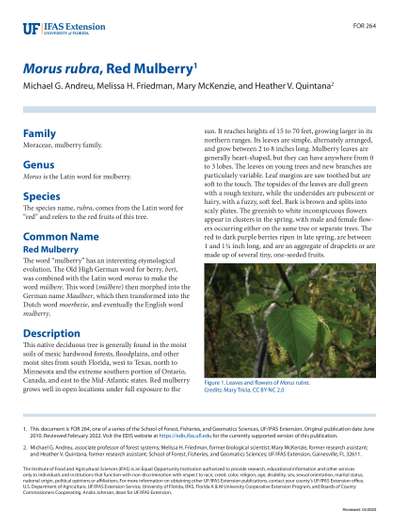
Description: This native deciduous tree is generally found in the moist soils of mesic hardwood forests, floodplains, and other moist sites from south Florida, west to Texas, north to Minnesota and the extreme southern portion of Ontario, Canada, and east to the Mid-Atlantic states. Red mulberry grows well in open locations under full exposure to the sun. It reaches heights of 15 to 70 feet, growing larger in its northern ranges. Its leaves are simple, alternately arranged, and grow between 2 to 8 inches long. Mulberry leaves are generally heart-shaped, but they can have anywhere from 0 to 3 lobes. The leaves on young trees and new branches are particularly variable. Leaf margins are saw toothed but are soft to the touch. The topsides of the leaves are dull green with a rough texture, while the undersides are pubescent or hairy, with a fuzzy, soft feel. Bark is brown and splits into scaly plates. The greenish to white inconspicuous flowers appear in clusters in the spring, with male and female flowers occurring either on the same tree or separate trees. The red to dark purple berries ripen in late spring, are between 1 and 1¼ inch long, and are an aggregate of drupelets or are made up of several tiny, one-seeded fruits.
The Muscadine Grape
HS763
The muscadine grape (Vitis rotundifolia Michx.) is native to the southeastern United States and was the first native grape species to be cultivated in North America. The natural range of muscadine grapes extends from Delaware to central Florida and occurs in all states along the Gulf Coast to east Texas. It also extends northward along the Mississippi River to Missouri. Muscadine grapes will perform well throughout Florida, although performance is poor in calcareous soils or in soils with very poor drainage. Most scientists divide the Vitis genus into two subgenera: Euvitis (the European, Vitis vinifera L. grapes and the American bunch grapes, Vitis labrusca L.) and the Muscadania grapes (muscadine grapes). There are three species within the Muscadania subgenera (Vitis munsoniana, Vitis popenoei and Vitis rotundifolia ). Euvitis and Muscadania have somatic chromosome numbers of 38 and 40, respectively. Vines do best in deep, fertile soils, and they can often be found in river beds.
1. This document is HS763, one of a series of the Horticultural Sciences Department, UF/IFAS Extension. Publication date: June 2003. Revised November 2010, October 2013, and January 2017. Please visit the EDIS website at http://edis.ifas.ufl.edu.
2. Peter C. Andersen, professor, NFREC-Quincy; Timothy E. Crocker, professor emeritus; and Jacque Breman, emeritus Extension agent IV, Columbia County, Horticultural Sciences Department, UF/IFAS Extension, Gainesville, FL 32611.
Papaya Growing in the Florida Home Landscape
HS11
Scientific name: Carica papaya L.
Common names: Papaya and pawpaw (English and Spanish), malakor, loko, ma kuai thet (Thai), and du du (Vietnamese).
Family: Caricaceae Origin: The origin and center of diversification is Central America.
Relatives: Mountain papaya [also called chamburo (Vasconcellea pubescens)] and babaco (Vasconella x heilbornii).
Distribution: Throughout the tropical and subtropical world; in protected culture in cool subtropical regions.
History: Papaya was taken to the Caribbean and Southeast Asia first and then spread to India, Oceania, and Africa.
Importance: Papaya is a major commercial crop throughout the tropical and subtropical world and exported widely to areas where production is not possible. Florida has a small commercial industry.
Invasive potential: Carica papaya has not been evaluated using the UF/IFAS Assessment of Non-Native Plants in Floridas Natural Areas (UF/IFAS Invasive Plant Working Group 2008).
1. This document is HS11, one of a series of the Horticultural Sciences Department, UF/IFAS Extension. Original publication date April 1994. Revised October 2005, October 2008, and November 2016. Reviewed December 2019. Visit the EDIS website at https://edis.ifas.ufl.edu for the currently supported version of this publication.
2. Jonathan H. Crane, professor and tropical fruit crop specialist, UF/IFAS Tropical Research and Education Center, Homestead, FL.
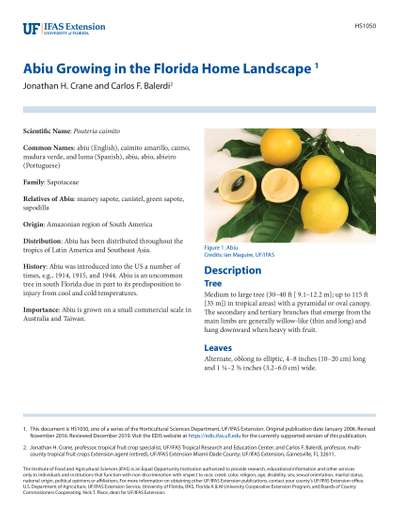
Abiu Growing in the Florida Home Landscape
HS1050
Scientific Name: Pouteria caimito
Common Names: abiu (English), caimito amarillo, caimo, madura verde, and luma (Spanish), abiu, abio, abieiro (Portuguese)
Family: Sapotaceae
Relatives of Abiu: mamey sapote, canistel, green sapote, sapodilla
Origin: Amazonian region of South America
Distribution: Abiu has been distributed throughout the tropics of Latin America and Southeast Asia.
1. This document is HS1050, one of a series of the Horticultural Sciences Department, UF/IFAS Extension. Original publication date January 2006. Revised November 2016. Reviewed December 2019. Visit the EDIS website at https://edis.ifas.ufl.edu for the currently supported version of this publication.
2. Jonathan H. Crane, professor, tropical fruit crop specialist, UF/IFAS Tropical Research and Education Center; and Carlos F. Balerdi, professor, multicounty tropical fruit crops Extension agent (retired), UF/IFAS Extension Miami-Dade County; UF/IFAS Extension, Gainesville, FL 32611.