HS763
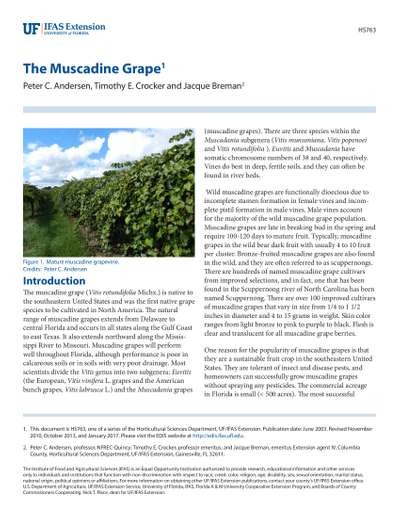
The muscadine grape (Vitis rotundifolia Michx.) is native to the southeastern United States and was the first native grape species to be cultivated in North America. The natural range of muscadine grapes extends from Delaware to central Florida and occurs in all states along the Gulf Coast to east Texas. It also extends northward along the Mississippi River to Missouri. Muscadine grapes will perform well throughout Florida, although performance is poor in calcareous soils or in soils with very poor drainage. Most scientists divide the Vitis genus into two subgenera: Euvitis (the European, Vitis vinifera L. grapes and the American bunch grapes, Vitis labrusca L.) and the Muscadania grapes (muscadine grapes). There are three species within the Muscadania subgenera (Vitis munsoniana, Vitis popenoei and Vitis rotundifolia ). Euvitis and Muscadania have somatic chromosome numbers of 38 and 40, respectively. Vines do best in deep, fertile soils, and they can often be found in river beds.
1. This document is HS763, one of a series of the Horticultural Sciences Department, UF/IFAS Extension. Publication date: June 2003. Revised November 2010, October 2013, and January 2017. Please visit the EDIS website at http://edis.ifas.ufl.edu.
2. Peter C. Andersen, professor, NFREC-Quincy; Timothy E. Crocker, professor emeritus; and Jacque Breman, emeritus Extension agent IV, Columbia County, Horticultural Sciences Department, UF/IFAS Extension, Gainesville, FL 32611.