Dear friends of ECHO,
We had a great symposium on neglected and underutilized crops in October and ECHO agriculture conference in November 2025. This Research Newsletter will update you on those events and alert you to a few research updates and opportunities for engagement.
Research Events
IV International Symposium on Underutilized Plant Species
 This event was held 20-24 October in Fort Myers, Florida, hosted by ECHO under the auspices of the International Society for Horticultural Science (ISHS). There were 72 participants, mostly university faculty and students along with ECHO staff.
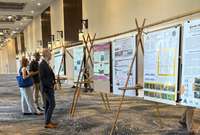
Research posters displayed on bamboo “A frames.” Source: ECHO staff
Through the symposium, ECHO played a significant role in advancing scientific knowledge in support of underutilized plants for resilient and thriving food systems. Research was shared via 22 posters, 30 oral breakout sessions, talks by 6 invited plenary speakers, all interspersed with time for discussion and networking. Work is ongoing for publishing approximately 40 research papers into an e-Acta Horticulturae Proceedings.
A day at ECHO’s Florida campus provided participants with a unique opportunity to tour our seed bank and demonstration gardens, and to participate in practical workshops, all of which augmented the scientific reports shared during the first two days of the symposium. The final day of the event included field excursions to surrounding agricultural sites, including the University of Florida’s Tropical Research and Education Center and nearby gardens that supply culturally-preferred produce to migrant farmworkers through the organization Cultivate Abundance.
As many of the universities represented were within the United States, we gained a greater appreciation for temperature species of underutilized plants. There were, for example, several presentations on native pawpaw, Asimina triloba. We also gained insights into the diversity of plants being utilized both globally and within the state of Florida. It was noted that advances in communication technology have made it easier for people around the world to learn about promising crops and how to use them.
Be aware that ISHS hosts numerous horticulture-related symposia around the world, with dates and locations accessible on the ISHS Calendar of Events web page. This page also has links to information about information and publications.
ECHO International Agriculture Conference (EIAC)
This is always a great opportunity to connect with research-minded members of ECHO’s global network and hear their ideas for future research. This year we devoted two evening sessions to gather input on 1) practices to validate and practices that are working but have not been shared widely; 2) how farmers receive information; and 3) ideas for evaluating the success of projects and interventions. Highlights of that discussion are below:
Practices or crop options that need more validation and dissemination
Participants were also asked to suggest ideas for building the capacity of ECHO’s network to conduct research and share findings. Suggestions included practical training for farmer-led research and local trials, replicated trials to encourage adoption of proven practices, and the use of ECHO Development Notes (EDN) as a platform to share research findings.
| Practices or crop options that need more validation with research | Practices or crop options with proven success but have not been shared widely |
|---|---|
| Annual crops for school-gardens with limited soil and short windows of time to garden | Bioliquid fertilizer, with more guidance on concentrations and method of application (e.g., soil drench vs foliar spray) |
| Biochar use with diverse soils | Small-scale community production of biochar |
| Low-maintenance bee-keeping | Fall armyworm control with chili and wood ash in Kenya [see Fall Armyworm Question and Answer in EDN 165 for information about the practice of applying soil to the whorl of maize plants to immobilize or kill the larvae.] |
| Nutritional information on Moringa stenopetala | 2-4-2 method of intercropping with sorghum and peanuts [see “2:4:2” Maize/Legume Intercropping Pattern in EDN 133 for more information about this intercropping method]. |
| Mixed cropping in food forest systems, identifying companion crops and methods to measure and manage shade | Growing roselle (Hibiscus sabdariffa) with field crops (Niger). |
| Crop combinations for resilient intercropping systems, including boundary line vegetation and high-density cover crop mixtures for biodiversity and soil health | Grain storage in hermetic (airtight) containers, with more application to large-scale seed storage [see Fill it Full in an ECHO Research Note for more information on this]. |
| Use of Camels Foot tree (Piliostigma sp.) for making soil water accessible to crops [See Intercropping Native Shrubs in EDN 142 for more information on this]. | Indigenous methods of grain storage, such as the hanging of maize on palm trees with rat prevention |
| Classify and study a local (in Ghana) Canavalia species-ECHO can reach out to university contacts/herbaria for assistance with plant ID | Culinary training on chaya [developing, documenting, and promoting cuisine is important for underutilized crops in general] |
| Small-scale aquaponics systems | Labor-saving tools such as the scuffle hoe |
| Natural pest management techniques | |
| Evaluation of bird-resistant sorghum varieties |
How farmers receive information
The extent to which knowledge gleaned from research benefits farmers depends on how farmers readily receive information. Insights from participants are broken down as follows:
| Trusted sources of information | Materials from entities including ECHO, USAID, and FAO. |
| Academia and scientific literature | |
| AccessAgriculture | |
| Other farmers: informal communication in the field or at the market | |
| Electronic media options | WhatsApp groups for knowledge exchange and farmer polling |
| Videos: short clips by extension officers or lead farmers to raise awareness and showcase community trials | |
| TikTok for oral-based communities | |
| Phones: recognize limitations of reliability and technical literacy | |
| Farmer-led training and knowledge sharing | Trainer of Trainers model |
| Farmer facilitators, promoters, and managers | |
| Coaching and accountability via local extensionists or lead farmers | |
| Visits to cooperative groups | |
| Community engagement methods | Skits and dramatizations |
| Visits to successful farms or projects | |
| Community-wide trials supported by digital media such as video |
Several overall principles emerged from the discussion. Those included:
- Utilization of trusted information sources
- Use of evidence-based information
- Honoring farmer knowledge and existing models of information exchange
- Blending of in-person sharing and digital tools
Ideas for monitoring and evaluation of project interventions
As farmers experiment with and implement promising practices or crops, there is a need for what ECHO often refers to as MEAL (Monitoring, Evaluation, Accountability, and Learning). Participants expressed interest in evaluation methods and asset mapping that are easy to implement. Their comments on MEAL are summarized in checklist form below:
| MEAL Category | Field Checklist |
| Design and Pre-Intervention Assessment | • Assess food use, consumption patterns, and market demand • Identify adoption barriers and incentives • Integrate socio-economic, cultural, and gender factors • Evaluate labor demands and system fit • Establish baselines before intervention • Use local units and appropriate measurements |
| Implementation Monitoring | • Apply participatory, farmer-led trial methods • Implement small, on-farm plots • Compare practices side-by-side • Monitor implementation across seasons • Document with photos and video • Track labor, inputs, and management requirements |
| Evaluation & Outcome Measurement | • Measure yields across treatment and comparison plots • Compare improved and traditional practices • Evaluate across multiple seasons • Use quasi-experimental comparisons where needed • Assess post-harvest loss and marketability of produce |
| Participation & Qualitative Evidence | • Collect farmer observations as evidence • Facilitate shared learning through field visits • Combine qualitative and quantitative data • Capture unintended outcomes and innovations • Gather feedback beyond formal trials |
| Adoption & Impact Pathways | • Analyze adoption drivers and constraints • Monitor informal and organic diffusion • Track behavior change • Examine partial or delayed adoption • Link results to livelihoods and food security |
| Learning, Adaptation & Use of Evidence | • Test interventions iteratively • Learn from failure and surprise • Feed evidence into planning and decisions • Refine technologies and delivery models |
As ECHO’s impact is shared with that of individuals and organizations who utilize our resources, their ability to measure the effectiveness of their interventions also helps ECHO to gain a better sense of the difference we are making. With that in mind, we worked with Plant With Purpose staff who authored an excellent article in EDN 171 entitled The Difference-in-Differences Approach to Evaluate the Impact of a Project. Let us know if you have additional insights to share about MEAL.
Research Trial Updates
Evaluation of home-made biochar kilns
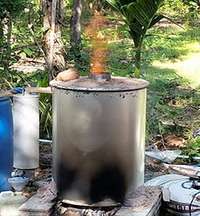
A Retort kiln. Source: ECHO staff
Excerpts of an ECHOcommunity Conversations post by Shaun Snoxell on research at ECHO Asia in collaboration with the National Metal and Materials Technology Centre of Thailand
ECHO Asia has tested three small scale biochar kilns to determine how the kiln design influences biochar characteristics. The study on biochar production was conducted using three types of kilns: the Retort Biochar Wood Vinegar Kiln (Retort Kiln), the Top-Lit Updraft Biochar Stove (TLUD), and the Kon-Tiki Biochar Stove (Kon-Tiki). Tests were conducted at ECHO Asia Impact Centre in Chiang Mai in April 2025. Maize cobs were used as the biomass in all three kilns. Temperature measurements were taken at three levels (top, middle, and bottom) for each kiln.
The findings showed that the Retort kiln produced the highest yield, with 28.2% of the maize cob biomass converted into biochar, followed by the TLUD kiln at 18.7%, and the Kon-Tiki kiln with the lowest yield at 16.9%. The retort kiln results in the highest pyrolysis temperature and longer duration, followed by the TLUD. These kilns are likely to produce high quality biochar with higher porosity and lower tar residue. The resulting produce is likely to be suitable for use in water filtration. The Kon-tiki is also capable of producing reasonable quality biochar for use as a soil amendment, but this will be more variable. The retort kiln is higher yielding than the other kilns and also produces wood vinegar as a by-product. [More data and photos of the other kilns can be viewed in the ECHOcommunity Conversations post].
Azolla and duckweed production for livestock feed
Excerpts of EDN 172 content by Shaun Snoxell and Nitin Rex Sancho on research at ECHO Asia
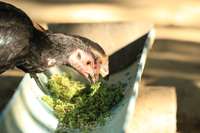
Chicken eating fresh azolla. Source: ECHO Asia Staff
Duckweed (Lemnaceae family) and azolla (Azolla genus) are two aquatic plants with high potential for use in livestock feed. In contexts where water is plentiful, production of these plants can be resource-efficient, requiring little financial or equipment input. In addition to their use as livestock feed, they have a range of useful applications such as water filtration and green manure.
At ECHO Asia, we feed both duckweed and azolla to chickens. We scoop plants out of the water using a plastic basket, and feed fresh plants directly to the chickens. We do not dry the plants before feeding. Chickens tend to find the azolla more palatable than the duckweed. However, in our context, duckweed tends to grow faster than azolla. Harvest and feeding takes just a few minutes.
ECHO Asia measured the increase in weight of duckweed and azolla per week under conventional management in November 2025. For each gram of duckweed added to a container, 4.5 grams were harvested after 7 days (doubling time in 3.23 days). For every gram of azolla added, 3 grams were harvested after 7 days (doubling time in 4.42 days). However, once the surface of the water is covered, or fertilization is delayed, the growth rate declined rapidly. [See EDN 172 for the full article]
Improving propagation techniques for four underutilized tropical species to increase adventitious rooting and establishment success
An update by Stacy Swartz from ECHO in Florida
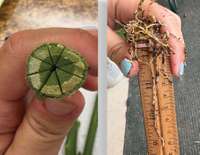
Wounded of cambial tissue at the base of a cutting (left) and rooting of a cutting (right).
As mentioned in the August 2025 newsletter, underutilized perennial vegetable species including chaya (Cnidoscolus aconitifolius); Haitian basket vine (Trichostigma octandrum); and katuk (Sauropus androgynus) as well as fodder species like gliricidia (Gliricidia sepium) are frequently propagated asexually using vegetative cuttings. However, the success of using cuttings is variable, and increasing rooting using simple techniques may improve cutting survival and shoot regrowth. Additional wounding of cambial tissue may increase the number of adventitious roots produced, leading to higher cutting survival. In July, 2025 we cut and sanitized cuttings of the above species at the ECHO North American
Regional Impact Center in Florida, USA, and divided into 6 treatments based on two main factors:
(1) air drying or not air drying the cuttings for one day before planting
(2) wounding the basal end of the cutting with a knife either once, 4 times, or not wounding.
All cuttings were randomly placed by species and replication into planting trays and maintained in similar greenhouse conditions. Here is what we’ve learned to date:
- Air drying (curing) a day before planting did not increase rooting.
- Chaya and katuk initiated more and longer roots at a faster rate than Haitian basket vine and gliricidia.
- The single cut or 4x cut to the base of cuttings explored in this study did not improve propagation success or root behavior on chaya but did generally increase the number of roots and root length of katuk cuttings.
Effect of NPK fertilizer on field establishment of chaya and Haitian basketvine with stem cuttings
There is not much research that has been done on field-level horticultural practices to optimize the growth and productivity of chaya and Haitian basketvine. This study is part of an ongoing effort to assess the potential to increase growth and yield of these perennial, dark leafy greens with added fertility. To date, we’ve compared four rates of N (0, 37.5, 100, and 137.5 g per plant) using 8-2-8 (N-P-K) fertilizer applied at the base of each cutting planted into four-plant field plots arranged in a randomized complete block design with four replications of each treatment (N rate). The cuttings were planted into the field in May 2025, at which time they received respective amounts of fertilizer. Cuttings that did take were replaced over time.
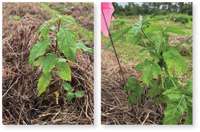
Haitian basketvine (left) and chaya (right) plants from stem cuttings planted directly into soil in the field.
A first round of data was taken in November 2025. What we’ve learned so far is that fertilizer amount had no effect on the final stand/count of live cuttings or the canopy width and area of either species. Success of field establishment with cuttings of these crops seems to be influenced more strongly by other factors (e.g., woody vs. soft tissue and planting cuttings in the rainy vs dry season) than fertilizer. With Haitian basketvine, for instance, we’ve had better success with woody than soft/green stem cuttings; soft cuttings have worked well in the greenhouse but die back in the field, likely an effect of too much sun, even with regular drip irrigation. Going forward, we plan to assess the effect of additional fertility inputs on canopy growth of these crops.

A processed ImageJ rendering of plot of four chaya plants, used to calculate canopy area and width
A freely-available software tool called ImageJ has been a convenient, non-destructive way to assess canopy area and width. It involves taking a photo directly above the canopy, with mulch or a white sheet on the ground. By including an object such as a ruler or stick of known length, the software calculates canopy parameters based on the green coloring (thus the importance of brown mulch or a white sheet on the ground to ensure that all the “green” is from the canopy as opposed to weeds on the ground). Perhaps this tool will be helpful to you in your research.
Opportunities for Engagement
- Would you be interested in conducting one or more trials suggested by EIAC 2025 conference participants (mentioned earlier in this newsletter)?
- Would farmers in your area be interested in trialing a promising variety or practice on a small portion (to minimize risk) of their land (for relevance under their growing conditions)? This could be as simple as two small plots comparing an innovation side-by-side with traditional practice. Let us know if this is something ECHO could work with you on. We could help with experimental design, deciding what to measure, and data analysis.
- Would you be interested in trialing crop varieties in your context? Let us know if you would like to explore methodologies for one or more crops you are interested in.
Best regards,

Tim Motis, Ph.D.
Global Research and Publications Director
ECHO Inc.
To correspond with ideas and feedback about the topics of
this newsletter, email publishing@echonet.org.