University of Florida Plant Information Avocado Growing in the Florida Home Landscape
Scientific Name: Persea americana Miller
Common Names: avocado, avocado-pear, aguacate (Spanish)
Family: Lauraceae
Origin: Avocados are indigenous to tropical America. Three ecological races—Mexican, Guatemalan, and West Indian—are recognized (Table 1).
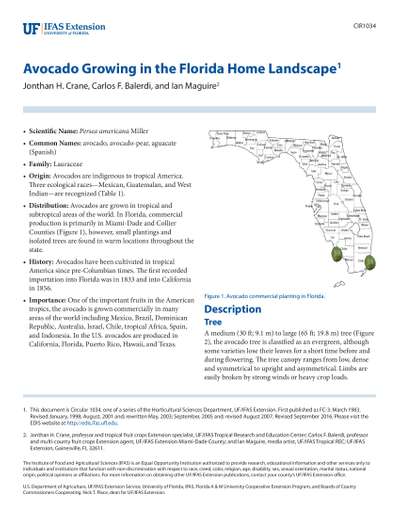
Distribution: Avocados are grown in tropical and subtropical areas of the world. In Florida, commercial production is primarily in Miami-Dade and Collier Counties (Figure 1), however, small plantings and isolated trees are found in warm locations throughout the state.
History: Avocados have been cultivated in tropical America since pre-Columbian times. The first recorded importation into Florida was in 1833 and into California in 1856.
Importance: One of the important fruits in the American tropics, the avocado is grown commercially in many areas of the world including Mexico, Brazil, Dominican Republic, Australia, Israel, Chile, tropical Africa, Spain, and Indonesia. In the U.S. avocados are produced in California, Florida, Puerto Rico, Hawaii, and Texas.
1. This document is Circular 1034, one of a series of the Horticultural Sciences Department, UF/IFAS Extension. First published as FC-3: March 1983. Revised January, 1998; August, 2001 and; rewritten May, 2003; September, 2005 and; revised August 2007. Revised September 2016. Please visit the EDIS website at http://edis.ifas.ufl.edu.
2. Jonthan H. Crane, professor and tropical fruit crops Extension specialist, UF/IFAS Tropical Research and Education Center; Carlos F. Balerdi, professor and multi-county fruit crops Extension agent, UF/IFAS Extension Miami-Dade County; and Ian Maguire, media artist, UF/IFAS Tropical REC; UF/IFAS Extension, Gainesville, FL 32611.