Florida Nursery Plant Sheets
26 Issues in this Publication (Showing 21 - 26) Previous
Pitangatuba: The Star Cherry
Common Name(s): Pitangatuba, Star Cherry
Scientific Name: Eugenia selloi (Eugenia neonitida)
Days to Harvest: 3-4 weeks from flowering
Light: Full sun to partial sun
Water: Moderate to high
Soil: Well draining, high organic content
Fertilizer: 2-3 times per year using a balanced fertilizer
Pests: Scale and caterpillars
Diseases: Root rot and leaf spot
Soursop: Annona muricata
The soursop tree is low-branching and bushy but slender because of its upturned limbs, and reaches a height of 25 or 30 ft (7.5-9 m). Young branchlets are rusty-hairy. The malodorous leaves, normally evergreen, are alternate, smooth, glossy, dark green on the upper surface, lighter beneath; oblong, elliptic or narrowobovate, pointed at both ends, 2 1/2 to 8 in (6.25-20 cm) long and 1 to 2 1/2 in (2.5-6.25 cm) wide. The flowers, which are borne singly, may emerge anywhere on the trunk, branches or twigs. They are short stalked, 1 1/2 to 2 in (4 5 cm) long, plump, and triangular-conical, the 3 fleshy, slightly spreading, outer petals yellow-green, the 3 close-set inner petals pale-yellow.
Morton, J. 1987. Soursop. p. 75–80. In: Fruits of warm climates. Julia F. Morton, Miami, FL.
Puerto Rican “Uplands” Taro: Colcasia esculenta
Common Names: Taro, dasheen, cocoyam, eddo
Mature taro plants reach 3-6 feet tall and wide. The leaves themselves can grow up to 3 feet in size. At the base of the plant is one main tuber, which stores nutrients to last the plant through the winter. Fibrous roots called corms grow from this tuber, as do several smaller tubers.
Our variety of taro comes from Cody Cove Farm in Polk County, FL.
From their website: “Grown in normal garden soil with irrigation, we can harvest 5-7 pounds of corms per plant reliably in a roughly 7 month growing window. Plants produce one large central corm and a good number of side cormels. Our best results in Central Florida have been planting in the last weeks of February or early March. Later plantings seem to have diminishing returns.”
Tropical Oregano: Plectranthus amboinicus
This perennial herb, known as Cuban oregano or Spanish thyme, has a similar tasate and aroma to its namesakes.
Culture: Blooms appear in a lavender rose, pastel violet, and white color. The leave are a lime green color. Cuban oregano is a flowering herb/perennial; it will last at least up to several years in its native climate. Cuban oregano is know for its habit of growing to a height of approximately 60.96 cm (1.98 feet). it is a low maintenance plant. Since it is a succulant, it can do well even when neglected. The plant grows easily, but doesn't grow out of control.
Grows well in any soil and enjoys a full/partial sun position.
Temperature sensitive (should be grown in a pot).
Katuk - Sauropus androgynus
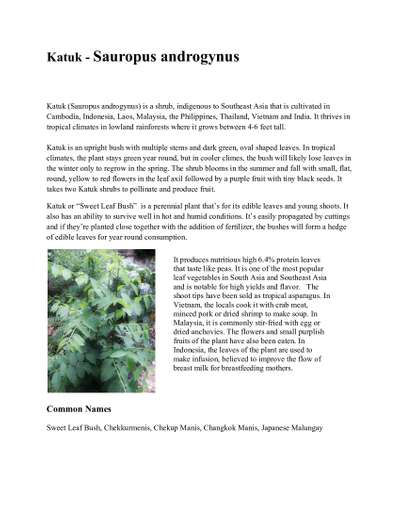
Katuk (Sauropus androgynus) is a shrub, indigenous to Southeast Asia that is cultivated in Cambodia, Indonesia, Laos, Malaysia, the Philippines, Thailand, Vietnam and India. It thrives in tropical climates in lowland rainforests where it grows between 4-6 feet tall.
Katuk is an upright bush with multiple stems and dark green, oval shaped leaves. In tropical climates, the plant stays green year round, but in cooler climes, the bush will likely lose leaves in the winter only to regrow in the spring. The shrub blooms in the summer and fall with small, flat, round, yellow to red flowers in the leaf axil followed by a purple fruit with tiny black seeds. It takes two Katuk shrubs to pollinate and produce fruit. Katuk or “Sweet Leaf Bush” is a perennial plant that’s for its edible leaves and young shoots. It also has an ability to survive well in hot and humid conditions. It’s easily propagated by cuttings and if they’re planted close together with the addition of fertilizer, the bushes will form a hedge of edible leaves for year round consumption.
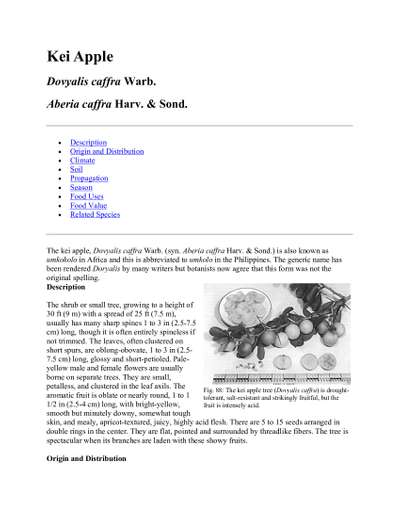
Kei Apple: Dovyalis caffra Warb., Aberia caffra Harv. & Sond.
The kei apple, Dovyalis caffra Warb. (syn. Aberia caffra Harv. & Sond.) is also known as umkokolo in Africa and this is abbreviated to umkolo in the Philippines. The generic name has been rendered Doryalis by many writers but botanists now agree that this form was not the original spelling.
Description
The shrub or small tree, growing to a height of 30 ft (9 m) with a spread of 25 ft (7.5 m), usually has many sharp spines 1 to 3 in (2.5-7.5 cm) long, though it is often entirely spineless if not trimmed. The leaves, often clustered on short spurs, are oblong-obovate, 1 to 3 in (2.5- 7.5 cm) long, glossy and short-petioled. Pale-yellow male and female flowers are usually borne on separate trees. They are small, petalless, and clustered in the leaf axils. The aromatic fruit is oblate or nearly round, 1 to 1 1/2 in (2.5-4 cm) long, with bright-yellow, smooth but minutely downy, somewhat tough skin, and mealy, apricot-textured, juicy, highly acid flesh. There are 5 to 15 seeds arranged in double rings in the center. They are flat, pointed and surrounded by threadlike fibers. The tree is spectacular when its branches are laden with these showy fruits.