FOR 264
Family: Moraceae, mulberry family.
Genus: Morus is the Latin word for mulberry.
Species: The species name, rubra, comes from the Latin word for “red” and refers to the red fruits of this tree.
Common Name: Red Mulberry The word “mulberry” has an interesting etymological evolution. The Old High German word for berry, beri, was combined with the Latin word morus to make the word múlbere. This word (múlbere) then morphed into the German name Maulbeer, which then transformed into the Dutch word moerbezie, and eventually the English word mulberry.
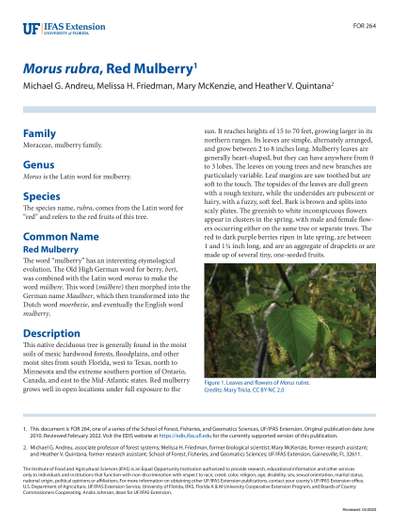
Description: This native deciduous tree is generally found in the moist soils of mesic hardwood forests, floodplains, and other moist sites from south Florida, west to Texas, north to Minnesota and the extreme southern portion of Ontario, Canada, and east to the Mid-Atlantic states. Red mulberry grows well in open locations under full exposure to the sun. It reaches heights of 15 to 70 feet, growing larger in its northern ranges. Its leaves are simple, alternately arranged, and grow between 2 to 8 inches long. Mulberry leaves are generally heart-shaped, but they can have anywhere from 0 to 3 lobes. The leaves on young trees and new branches are particularly variable. Leaf margins are saw toothed but are soft to the touch. The topsides of the leaves are dull green with a rough texture, while the undersides are pubescent or hairy, with a fuzzy, soft feel. Bark is brown and splits into scaly plates. The greenish to white inconspicuous flowers appear in clusters in the spring, with male and female flowers occurring either on the same tree or separate trees. The red to dark purple berries ripen in late spring, are between 1 and 1¼ inch long, and are an aggregate of drupelets or are made up of several tiny, one-seeded fruits.