University of Florida Plant Information Growing Feijoa Fruit in Florida
HS1424
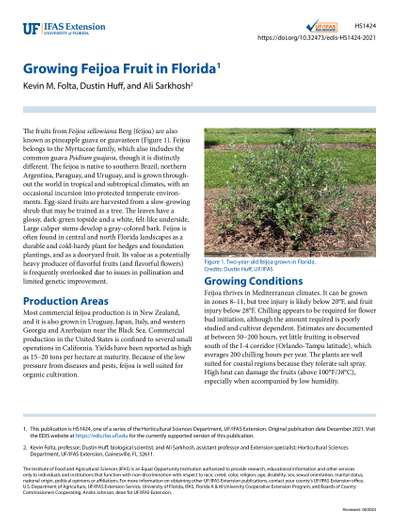
Te fruits from Feijoa sellowiana Berg (feijoa) are also known as pineapple guava or guavasteen (Figure 1). Feijoa belongs to the Myrtaceae family, which also includes the common guava Psidium guajava, though it is distinctly diferent. Te feijoa is native to southern Brazil, northern Argentina, Paraguay, and Uruguay, and is grown throughout the world in tropical and subtropical climates, with an occasional incursion into protected temperate environments. Egg-sized fruits are harvested from a slow-growing shrub that may be trained as a tree. Te leaves have a glossy, dark-green topside and a white, felt-like underside. Large caliper stems develop a gray-colored bark. Feijoa is ofen found in central and north Florida landscapes as a durable and cold-hardy plant for hedges and foundation plantings, and as a dooryard fruit. Its value as a potentially heavy producer of favorful fruits (and favorful fowers) is frequently overlooked due to issues in pollination and limited genetic improvement.
1. This publication is HS1424, one of a series of the Horticultural Sciences Department, UF/IFAS Extension. Original publication date December 2021. Visit the EDIS website at https://edis.ifas.uf.edu for the currently supported version of this publication.
2. Kevin Folta, professor; Dustin Huf, biological scientist; and Ali Sarkhosh, assistant professor and Extension specialist; Horticultural Sciences Department, UF/IFAS Extension, Gainesville, FL 32611.