The University of Florida (UF) provides numerous plant information PDFs through its IFAS Extension and the Florida-Friendly Landscaping program. Key publications include the Florida-Friendly Landscaping™ Guide to Plant Selection & Landscape Design and guides on low-maintenance and regionally specific plants, such as the one for south Florida. Other PDFs cover specific topics like vegetable production, tree fact sheets on planting and pruning, and invasive species information.
82 Issues in this Publication (Showing issues - ) Next
Ackee Growing in the Florida Home Landscape
HS1128
Scientific Name: Blighia sapida
Common Names: ackee, akee, achee, vegetable brains
Family: Sapindaceae
Relatives: lychee, longan, rambutan
Origin: Indigenous to the Ivory Coast and Gold Coast of West tropical Africa.
Distribution: Trees may also be found in many Caribbean countries (Jamaica, Trinidad, Haiti, Bahamas), Central America (e.g., Costa Rica, Panama, Guatemala), South America (Brazil, Venezuela, Surinam, Colombia, Ecuador), as well as the United States, (Florida).
History: The species was brought to Jamaica in 1793 by Captain Bligh and is now naturalized throughout that country.
Low-Chill Apple Cultivars for North Florida and North Central Florida
HS764
Relatively few cultivars of apples (Malus domestica L.) have been reported to be grown successfully in Florida. Northern apple cultivars, such as ‘Golden Delicious’, ‘Red Delicious’, ‘Gala’, or ‘Fuji’, are not exposed to enough low temperatures during Florida’s mild winters. Apple cultivars have what is known as a chilling requirement. Chilling requirement is the amount of cold temperatures during the winter required for normal vegetative and reproductive growth in the spring. The chilling requirement may be determined by the cumulative number of hours less than or equal to 45°F during the winter. Each hour is referred to as a chill unit. There are relatively few apple cultivars with a low enough chilling requirement to be successfully grown in Florida.
This document is HS764, one of a series of the Horticultural Sciences Department, UF/IFAS Extension. Original publication date December 2000.
1. Revised May 2019 and November 2022. Visit the EDIS website at https://edis.ifas.ufl.edu for the currently supported version of this publication.
2. Peter C. Andersen, professor emeritus; Muhammad A. Shahid, assistant professor, Horticultural Sciences Department, UF/IFAS North Florida Research
and Education Center, Quincy, FL; and Kevin Folta, professor, Horticultural Sciences Department; UF/IFAS Extension, Gainesville, FL 32611.
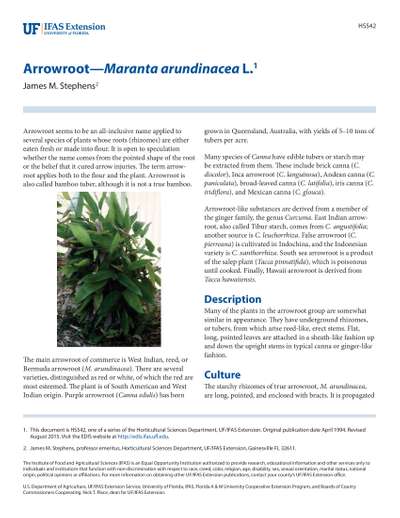
Arrowroot—Maranta arundinacea L.
Many of the plants in the arrowroot group are somewhat similar in appearance. They have underground rhizomes, or tubers, from which arise reed-like, erect stems. Flat, long, pointed leaves are attached in a sheath-like fashion up and down the upright stems in typical canna or ginger-like fashion.
1. This document is HS542, one of a series of the Horticultural Sciences Department, UF/IFAS Extension. Original publication date April 1994. Revised August 2015. Visit the EDIS website at http://edis.ifas.ufl.edu.
2. James M. Stephens, professor emeritus, Horticultural Sciences Department, UF/IFAS Extension, Gainesville FL 32611.
Atemoya Growing in the Florida Home Landscape
Common names for atemoya: annon, custard apple
Scientific name for atemoya: Annona squamosa x A. cherimola and A. cherimola x A. squamosa hybrids
Family: Annonaceae Origin: The atemoya is derived from man-made and natural hybrids. Relatives of atemoya: sugar apple (Annona squamosa), cherimoya (A. cherimola), soursop (A. muricata), custard apple (A. reticulata), pond apple (A. glabra), ilama (A. diversifolia)
Distribution: Atemoyas are grown throughout the subtropics and tropics. In Florida, atemoya production is restricted to warm locations along the lower southeast and southwest coasts. However, home landscape trees may be found along the southeastern shore of Lake Okeechobee and in warm protected locations along the lower east and west coasts.
Importance: Atemoya trees are not common in the home landscape. However, due to their superior cold tolerance and excellent fruit quality atemoya trees should be more widely planted in south Florida.
1. This document is HS64, one of a series of the Horticultural Sciences Department, UF/IFAS Extension. Original publication date October 1979. Revised April 1994, October 2005, October 2008, and November 2016. Reviewed December 2019. Visit the EDIS website at https://edis.ifas.ufl.edu for the currently supported version of this publication. Jonathan H. Crane, Carlos F. Balerdi, and Ian Maguire2
2. Jonathan H. Crane, professor, tropical fruit crop specialist, UF/IFAS Tropical Research and Education Center; Carlos F. Balerdi, professor, multi-county tropical fruit crops Extension agent (retired), UF/IFAS Extension Miami-Dade County; Ian Maguire, media artist (former), UF/IFAS Tropical Research and Education Center; UF/IFAS Extension, Gainesville, FL 32611.
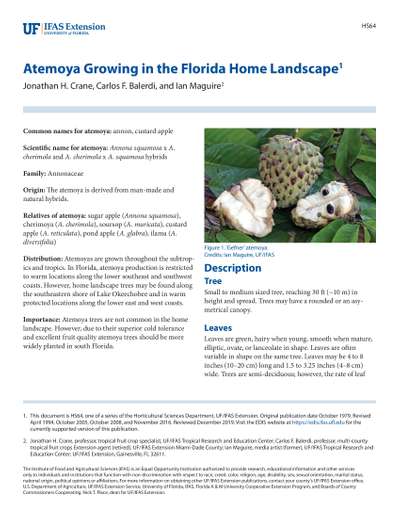
Avocado Growing in the Florida Home Landscape
Scientific Name: Persea americana Miller
Common Names: avocado, avocado-pear, aguacate (Spanish)
Family: Lauraceae
Origin: Avocados are indigenous to tropical America. Three ecological races—Mexican, Guatemalan, and West Indian—are recognized (Table 1).
Distribution: Avocados are grown in tropical and subtropical areas of the world. In Florida, commercial production is primarily in Miami-Dade and Collier Counties (Figure 1), however, small plantings and isolated trees are found in warm locations throughout the state.
History: Avocados have been cultivated in tropical America since pre-Columbian times. The first recorded importation into Florida was in 1833 and into California in 1856.
Importance: One of the important fruits in the American tropics, the avocado is grown commercially in many areas of the world including Mexico, Brazil, Dominican Republic, Australia, Israel, Chile, tropical Africa, Spain, and Indonesia. In the U.S. avocados are produced in California, Florida, Puerto Rico, Hawaii, and Texas.
1. This document is Circular 1034, one of a series of the Horticultural Sciences Department, UF/IFAS Extension. First published as FC-3: March 1983. Revised January, 1998; August, 2001 and; rewritten May, 2003; September, 2005 and; revised August 2007. Revised September 2016. Please visit the EDIS website at http://edis.ifas.ufl.edu.
2. Jonthan H. Crane, professor and tropical fruit crops Extension specialist, UF/IFAS Tropical Research and Education Center; Carlos F. Balerdi, professor and multi-county fruit crops Extension agent, UF/IFAS Extension Miami-Dade County; and Ian Maguire, media artist, UF/IFAS Tropical REC; UF/IFAS Extension, Gainesville, FL 32611.
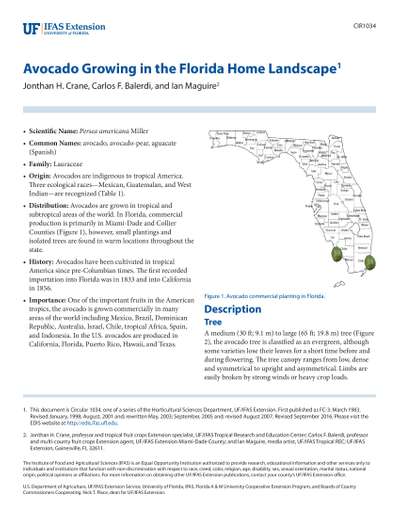
Banana Growing in the Florida Home Landscape
Scientific name: Musa acuminata and Musa balbisiana
Common names for banana: English—banana, plantain; Spanish—banano, platano, guineo, cambur
Common names for plantain: English—plantain, horse banana; Spanish—platano
Family: Musaceae
Relatives of banana within the Order Zingiberales: Numerous ornamental plants, including traveler’s palm, bird-of-paradise, heliconia, and ginger.
1. This document is HS10 (originally published as FC-10), one of a series of the Horticultural Sciences Department, UF/IFAS Extension. Original publication date October 1971. Revised January 1998, December 2005, October 2008, and November 2016. Reviewed December 2019. Visit the EDIS website at https://edis.ifas.ufl.edu for the currently supported version of this publication.
2. Jonathan H. Crane, professor and tropical fruit crops specialist, UF/IFAS Tropical Research and Education Center; and Carlos F. Balerdi, professor and multi-county tropical fruit crops Extension agent (retired), UF/IFAS Extension Miami-Dade County; UF/IFAS Extension, Gainesville, FL 32611.
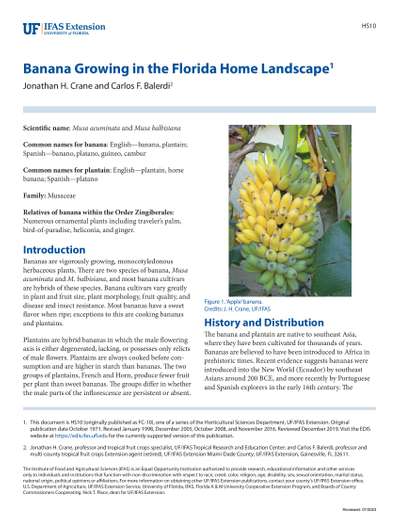
Malpighia glabra Barbados Cherry, Wild Crapemyrtle
FPS-390
Scientific name: Malpighia glabra
Pronunciation: mal-PIG-ee-uh GLAY-bruh
Common name(s): Barbados cherry, wild crapemyrtle
Family: Malpighiaceae
Plant type: tree USDA hardiness zones: 9B through 11 (Figure 4)
Planting month for zone 9: year round
Planting month for zone 10 and 11: year round Origin: not native to North America Invasive potential: not known to be invasive
Uses: specimen; container or above-ground planter; border; hedge; near a deck or patio; screen
Availability: somewhat available, may have to go out of the region to find the plant
1. This document is FPS-390, one of a series of the Department of Environmental Horticulture, UF/IFAS Extension. Original publication date October 1999. Revised October 2023. Visit the EDIS website at https://edis.ifas.ufl.edu for the currently supported version of this publication.
2. Edward F. Gilman, professor emeritus; Ryan W. Klein, assistant professor, arboriculture; and Gail Hansen, professor, sustainable landscape design; Department of Environmental Horticulture, UF/IFAS Extension, Gainesville, FL 32611.
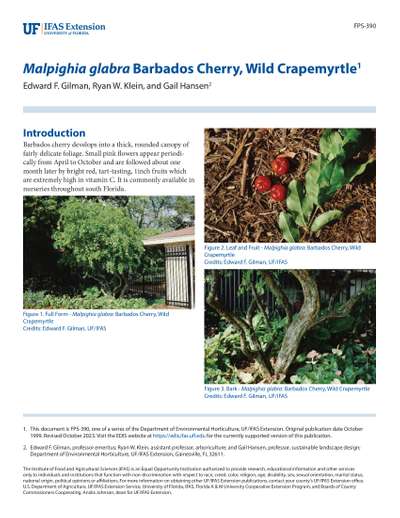
Callicarpa americana American Beautyberry
FPS90
Scientific name: Callicarpa americana
Pronunciation: kal-lick-AR-puh uh-mair-rick-KAY-nuh
Common name(s): American beautyberry, American mulberry
Family: Lamiaceae
Plant type: shrub
USDA hardiness zones: 7 through 11 (Figure 4)
Planting month for zone 7: year round
Planting month for zone 8: year round
Planting month for zone 9: year round
Planting month for zone 10 and 11: year round
Origin: native to Florida
Invasive potential: may self-seed each year
Uses: foundation; border; mass planting; container or aboveground planter; naturalizing
Availability: somewhat available, may have to go out of the region to find the plant
1. This document is FPS90, one of a series of the Environmental Horticulture Department, UF/IFAS Extension. Original publication date October 1999. Revised July 2022. Visit the EDIS website at https://edis.ifas.ufl.edu for the currently supported version of this publication.
2. Edward F. Gilman, professor, Environmental Horticulture Department, UF/IFAS Extension, Gainesville, FL 32611.
The Blackberry
HS807
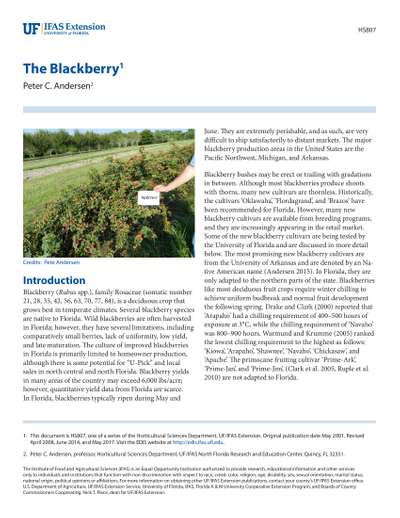
Blackberry (Rubus spp.), family Rosaceae (somatic number 21, 28, 35, 42, 56, 63, 70, 77, 84), is a deciduous crop that grows best in temperate climates. Several blackberry species are native to Florida. Wild blackberries are often harvested in Florida; however, they have several limitations, including comparatively small berries, lack of uniformity, low yield, and late maturation. The culture of improved blackberries in Florida is primarily limited to homeowner production, although there is some potential for “U-Pick” and local sales in north central and north Florida. Blackberry yields in many areas of the country may exceed 6,000 lbs/acre; however, quantitative yield data from Florida are scarce. In Florida, blackberries typically ripen during May and June. They are extremely perishable, and as such, are very difficult to ship satisfactorily to distant markets. The major blackberry production areas in the United States are the Pacific Northwest, Michigan, and Arkansas.
1. This document is HS807, one of a series of the Horticultural Sciences Department, UF/IFAS Extension. Original publication date May 2001. Revised April 2008, June 2014, and May 2017. Visit the EDIS website at http://edis.ifas.ufl.edu.
2. Peter C. Andersen, professor, Horticultural Sciences Department; UF/IFAS North Florida Research and Education Center, Quincy, FL 32351.
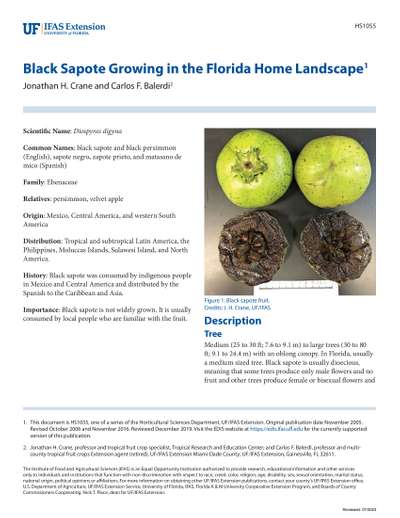
Black Sapote Growing in the Florida Home Landscape
Scientific Name: Diospyros digyna
Common Names: black sapote and black persimmon (English), sapote negro, zapote prieto, and matasano de mico (Spanish)
Family: Ebenaceae
Relatives: persimmon, velvet apple
Origin: Mexico, Central America, and western South America
Distribution: Tropical and subtropical Latin America, the Philippines, Moluccas Islands, Sulawesi Island, and North America.
History: Black sapote was consumed by indigenous people in Mexico and Central America and distributed by the Spanish to the Caribbean and Asia.
Importance: Black sapote is not widely grown. It is usually consumed by local people who are familiar with the fruit.
1. This document is HS1055, one of a series of the Horticultural Sciences Department, UF/IFAS Extension. Original publication date November 2005. Revised October 2006 and November 2016. Reviewed December 2019. Visit the EDIS website at https://edis.ifas.ufl.edu for the currently supported version of this publication.
2. Jonathan H. Crane, professor and tropical fruit crop specialist, Tropical Research and Education Center; and Carlos F. Balerdi, professor and multicounty tropical fruit crops Extension agent (retired), UF/IFAS Extension Miami-Dade County; UF/IFAS Extension, Gainesville, FL 32611.