The University of Florida (UF) provides numerous plant information PDFs through its IFAS Extension and the Florida-Friendly Landscaping program. Key publications include the Florida-Friendly Landscaping™ Guide to Plant Selection & Landscape Design and guides on low-maintenance and regionally specific plants, such as the one for south Florida. Other PDFs cover specific topics like vegetable production, tree fact sheets on planting and pruning, and invasive species information.
27 Issues in this Publication (Showing issues - 1) Previous
Lychee Growing in the Florida Home Landscape
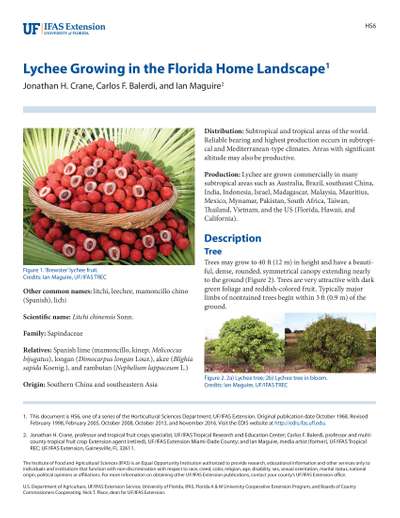
Other common names: litchi, leechee, mamoncillo chino (Spanish), lichi
Scientific name: Litchi chinensis Sonn.
Family: Sapindaceae
Relatives: Spanish lime (mamoncillo, kinep; Melicoccus bijugatus), longan (Dimocarpus longan Lour.), akee (Blighia sapida Koenig.), and rambutan (Nephelium lappaceum L.)
Origin: Southern China and southeastern Asia
Distribution: Subtropical and tropical areas of the world. Reliable bearing and highest production occurs in subtropical and Mediterranean-type climates. Areas with significant altitude may also be productive.
Production: Lychee are grown commercially in many subtropical areas such as Australia, Brazil, southeast China, India, Indonesia, Israel, Madagascar, Malaysia, Mauritius, Mexico, Mynamar, Pakistan, South Africa, Taiwan, Thailand, Vietnam, and the US (Florida, Hawaii, and California).
1. This document is HS6, one of a series of the Horticultural Sciences Department, UF/IFAS Extension. Original publication date October 1968. Revised February 1998, February 2005, October 2008, October 2013, and November 2016. Visit the EDIS website at http://edis.ifas.ufl.edu.
2. Jonathan H. Crane, professor and tropical fruit crops specialist, UF/IFAS Tropical Research and Education Center; Carlos F. Balerdi, professor and multicounty tropical fruit crop Extension agent (retired), UF/IFAS Extension Miami-Dade County; and Ian Maguire, media artist (former), UF/IFAS Tropical REC; UF/IFAS Extension, Gainesville, FL 32611.
The Fig
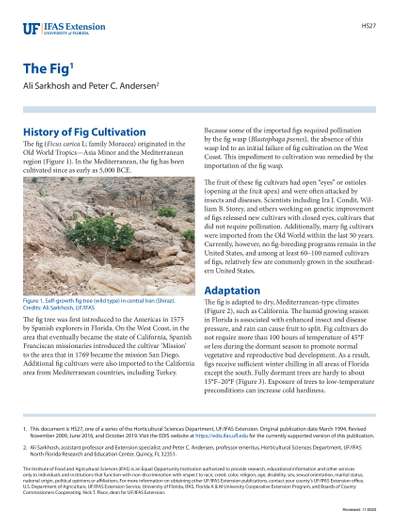
The fig (Ficus carica L; family Moracea) originated in the Old World Tropics—Asia Minor and the Mediterranean region (Figure 1). In the Mediterranean, the fig has been cultivated since as early as 5,000 BCE.
The fig tree was first introduced to the Americas in 1575 by Spanish explorers in Florida. On the West Coast, in the area that eventually became the state of California, Spanish Franciscan missionaries introduced the cultivar ‘Mission’ to the area that in 1769 became the mission San Diego. Additional fig cultivars were also imported to the California area from Mediterranean countries, including Turkey.
Jackfruit Growing in the Florida Home Landscape
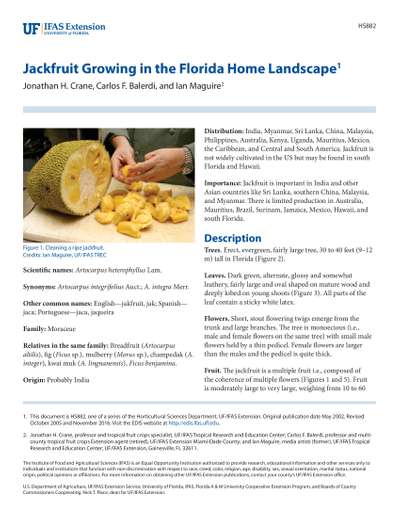
Scientific names: Artocarpus heterophyllus Lam.
Synonyms: Artocarpus integrifolius Auct.; A. integra Merr.
Other common names: English—jakfruit, jak; Spanish— jaca; Portuguese—jaca, jaqueira Family: Moraceae
Relatives in the same family: Breadfruit (Artocarpus altilis), fig (Ficus sp.), mulberry (Morus sp.), champedak (A. integer), kwai muk (A. lingnanensis), Ficus benjamina.
Origin: Probably India
Distribution: India, Myanmar, Sri Lanka, China, Malaysia, Philippines, Australia, Kenya, Uganda, Mauritius, Mexico, the Caribbean, and Central and South America. Jackfruit is not widely cultivated in the US but may be found in south Florida and Hawaii.
Importance: Jackfruit is important in India and other Asian countries like Sri Lanka, southern China, Malaysia, and Myanmar. There is limited production in Australia, Mauritius, Brazil, Surinam, Jamaica, Mexico, Hawaii, and south Florida.
1. This document is HS882, one of a series of the Horticultural Sciences Department, UF/IFAS Extension. Original publication date May 2002. Revised October 2005 and November 2016. Visit the EDIS website at http://edis.ifas.ufl.edu.
2. Jonathan H. Crane, professor and tropical fruit crops specialist, UF/IFAS Tropical Research and Education Center; Carlos F. Balerdi, professor and multicounty tropical fruit crops Extension agent (retired), UF/IFAS Extension Miami-Dade County; and Ian Maguire, media artisti (former), UF/IFAS Tropical Research and Education Center; UF/IFAS Extension, Gainesville, FL 32611.
Spondias Growing in the Florida Home Landscape
HS63
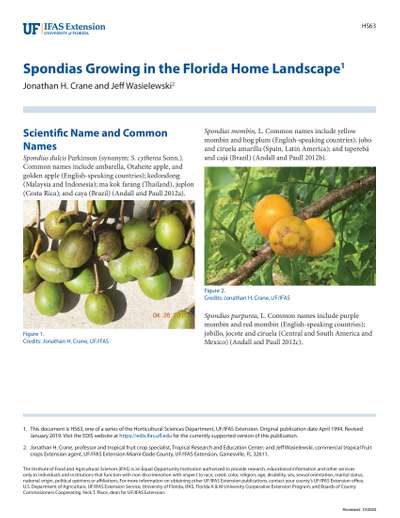
Spondias dulcis Parkinson (synonym: S. cytherea Sonn.). Common names include ambarella, Otaheite apple, and golden apple (English-speaking countries); kedondong (Malaysia and Indonesia); ma kok farang (Thailand), juplon (Costa Rica); and caya (Brazil) (Andall and Paull 2012a).
Spondias mombin, L. Common names include yellow mombin and hog plum (English-speaking countries); jobo and ciruela amarilla (Spain, Latin America); and taperebá and cajá (Brazil) (Andall and Paull 2012b).
1. This document is HS63, one of a series of the Horticultural Sciences Department, UF/IFAS Extension. Original publication date April 1994. Revised January 2019. Visit the EDIS website at https://edis.ifas.ufl.edu for the currently supported version of this publication.
2. Jonathan H. Crane, professor and tropical fruit crop specialist, Tropical Research and Education Center; and Jeff Wasielewski, commercial tropical fruit crops Extension agent, UF/IFAS Extension Miami-Dade County, UF/IFAS Extension, Gainesville, FL 32611.
Carissa grandiflora Natal Plum, Common Carissa1
FPS107
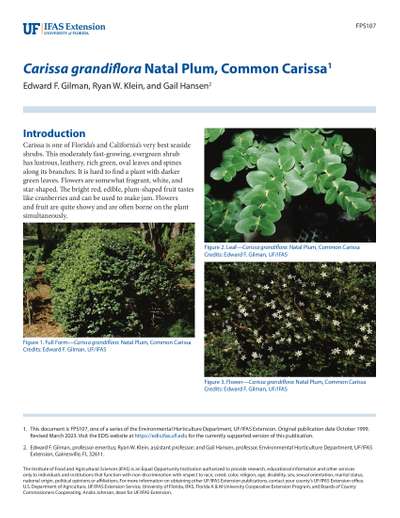
Scientific name: Carissa grandiflora
Pronunciation: kuh-RISS-uh gran-dif-FLOR-uh
Common name(s): natal plum, common carissa
Family: Apocynaceae Plant type: ground cover
USDA hardiness zones: 9B through 11 (Figure 5)
Planting month for zone 9: year round
Planting month for zone 10 and 11: year round
Origin: not native to North America
Invasive potential: not known to be invasive
Uses: bonsai; foundation; screen; border; mass planting; container or above-ground planter; fruit; espalier; ground cover; superior hedge; small parking lot islands (< 100 square feet in size); medium-sized parking lot islands (100–200 square feet in size); large parking lot islands (> 200 square feet in size)
Availability: generally available in many areas within its hardiness range
1. This document is FPS107, one of a series of the Environmental Horticulture Department, UF/IFAS Extension. Original publication date October 1999. Revised March 2023. Visit the EDIS website at https://edis.ifas.ufl.edu for the currently supported version of this publication.
2. Edward F. Gilman, professor emeritus; Ryan W. Klein, assistant professor; and Gail Hansen, professor, Environmental Horticulture Department, UF/IFAS Extension, Gainesville, FL 32611.
Phoenix roebelenii: Pygmy Date Palm
ENH-600
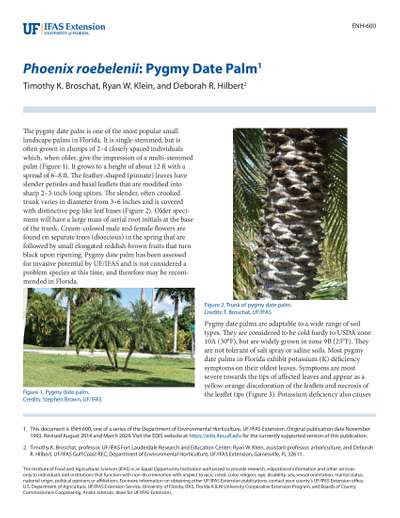
The pygmy date palm is one of the most popular small landscape palms in Florida. It is single-stemmed, but is often grown in clumps of 2–4 closely spaced individuals which, when older, give the impression of a multi-stemmed palm (Figure 1). It grows to a height of about 12 ft with a spread of 6–8 ft. The feather-shaped (pinnate) leaves have slender petioles and basal leaflets that are modified into sharp 2–3-inch-long spines. The slender, often crooked trunk varies in diameter from 3–6 inches and is covered with distinctive peg-like leaf bases (Figure 2). Older specimens will have a large mass of aerial root initials at the base of the trunk. Cream-colored male and female flowers are found on separate trees (dioecious) in the spring that are followed by small elongated reddish-brown fruits that turn black upon ripening. Pygmy date palm has been assessed for invasive potential by UF/IFAS and is not considered a problem species at this time, and therefore may be recommended in Florida.
1. This document is ENH-600, one of a series of the Department of Environmental Horticulture, UF/IFAS Extension. Original publication date November 1993. Revised August 2014 and March 2024. Visit the EDIS website at https://edis.ifas.ufl.edu for the currently supported version of this publication.
2. Timothy K. Broschat, professor, UF/IFAS Fort Lauderdale Research and Education Center; Ryan W. Klein, assistant professor, arboriculture, and Deborah R. Hilbert, UF/IFAS Gulf Coast REC; Department of Environmental Horticulture, UF/IFAS Extension, Gainesville, FL 32611.
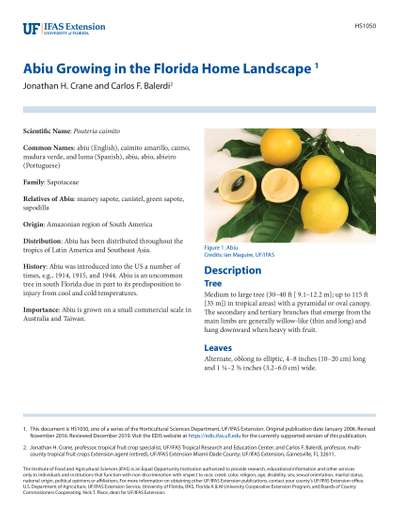
Abiu Growing in the Florida Home Landscape
HS1050
Scientific Name: Pouteria caimito
Common Names: abiu (English), caimito amarillo, caimo, madura verde, and luma (Spanish), abiu, abio, abieiro (Portuguese)
Family: Sapotaceae
Relatives of Abiu: mamey sapote, canistel, green sapote, sapodilla
Origin: Amazonian region of South America
Distribution: Abiu has been distributed throughout the tropics of Latin America and Southeast Asia.
1. This document is HS1050, one of a series of the Horticultural Sciences Department, UF/IFAS Extension. Original publication date January 2006. Revised November 2016. Reviewed December 2019. Visit the EDIS website at https://edis.ifas.ufl.edu for the currently supported version of this publication.
2. Jonathan H. Crane, professor, tropical fruit crop specialist, UF/IFAS Tropical Research and Education Center; and Carlos F. Balerdi, professor, multicounty tropical fruit crops Extension agent (retired), UF/IFAS Extension Miami-Dade County; UF/IFAS Extension, Gainesville, FL 32611.