The University of Florida (UF) provides numerous plant information PDFs through its IFAS Extension and the Florida-Friendly Landscaping program. Key publications include the Florida-Friendly Landscaping™ Guide to Plant Selection & Landscape Design and guides on low-maintenance and regionally specific plants, such as the one for south Florida. Other PDFs cover specific topics like vegetable production, tree fact sheets on planting and pruning, and invasive species information.
22 Issues in this Publication (Showing issues - ) Previous | Next
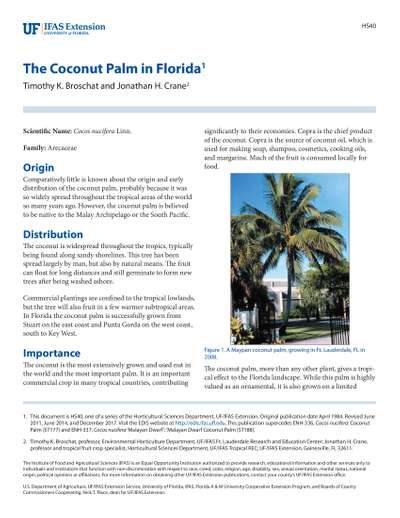
The Coconut Palm in Florida
Scientific Name: Cocos nucifera Linn.
Family: Arecaceae
Origin: Comparatively little is known about the origin and early distribution of the coconut palm, probably because it was so widely spread throughout the tropical areas of the world so many years ago. However, the coconut palm is believed to be native to the Malay Archipelago or the South Pacific.
Distribution: The coconut is widespread throughout the tropics, typically being found along sandy shorelines. This tree has been spread largely by man, but also by natural means. The fruit can float for long distances and still germinate to form new trees after being washed ashore. Commercial plantings are confined to the tropical lowlands, but the tree will also fruit in a few warmer subtropical areas. In Florida the coconut palm is successfully grown from Stuart on the east coast and Punta Gorda on the west coast, south to Key West.
Importance: The coconut is the most extensively grown and used nut in the world and the most important palm. It is an important commercial crop in many tropical countries, contributing significantly to their economies. Copra is the chief product of the coconut. Copra is the source of coconut oil, which is used for making soap, shampoo, cosmetics, cooking oils, and margarine. Much of the fruit is consumed locally for food.
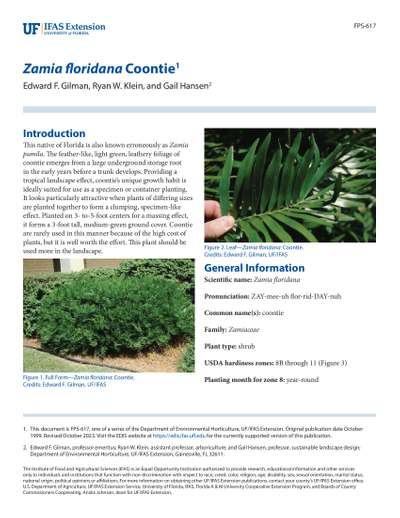
Zamia floridana Coontie
Scientific name: Zamia floridana
Pronunciation: ZAY-mee-uh flor-rid-DAY-nuh
Common name(s): coontie Family: Zamiaceae Plant type: shrub
USDA hardiness zones: 8B through 11 (Figure 3)
Planting month for zone 8: year-round
Planting month for zone 9: year-round
Planting month for zone 10 and 11: year-round
Origin: native to Florida Invasive potential: not known to be invasive
Uses: border; mass planting; accent; attracts butterflies; suitable for growing indoors
Availability: somewhat available, may have to go out of the region to find the plant
1. This document is FPS-617, one of a series of the Department of Environmental Horticulture, UF/IFAS Extension. Original publication date October 1999. Revised October 2023. Visit the EDIS website at https://edis.ifas.ufl.edu for the currently supported version of this publication.
2. Edward F. Gilman, professor emeritus; Ryan W. Klein, assistant professor, arboriculture; and Gail Hansen, professor, sustainable landscape design; Department of Environmental Horticulture, UF/IFAS Extension, Gainesville, FL 32611.
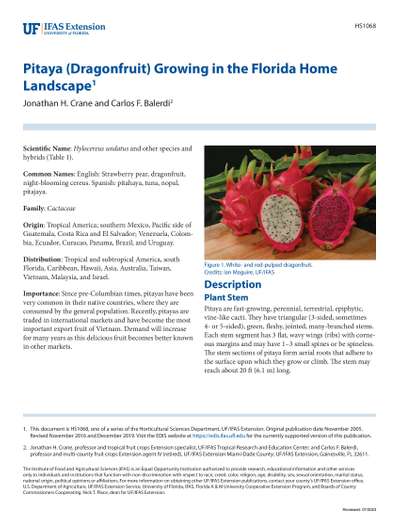
Pitaya (Dragonfruit) Growing in the Florida Home Landscape
Scientific Name: Hylocereus undatus and other species and hybrids (Table 1).
Common Names: English: Strawberry pear, dragonfruit, night-blooming cereus. Spanish: pitahaya, tuna, nopal, pitajaya.
Family: Cactaceae Origin: Tropical America; southern Mexico, Pacific side of Guatemala, Costa Rica and El Salvador; Venezuela, Colombia, Ecuador, Curacao, Panama, Brazil, and Uruguay.
Distribution: Tropical and subtropical America, south Florida, Caribbean, Hawaii, Asia, Australia, Taiwan, Vietnam, Malaysia, and Israel.
Importance: Since pre-Columbian times, pitayas have been very common in their native countries, where they are consumed by the general population. Recently, pitayas are traded in international markets and have become the most important export fruit of Vietnam. Demand will increase for many years as this delicious fruit becomes better known in other markets.
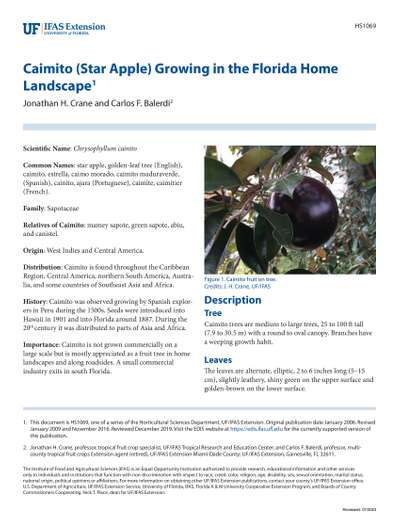
Caimito (Star Apple) Growing in the Florida Home Landscape
Scientific Name: Chrysophyllum cainito
Common Names: star apple, golden-leaf tree (English), caimito, estrella, caimo morado, caimito maduraverde, (Spanish), cainito, ajara (Portuguese), caimite, caimitier (French).
Family: Sapotaceae
Relatives of Caimito: mamey sapote, green sapote, abiu, and canistel.
Origin: West Indies and Central America. Distribution: Caimito is found throughout the Caribbean Region, Central America, northern South America, Australia, and some countries of Southeast Asia and Africa.
History: Caimito was observed growing by Spanish explorers in Peru during the 1500s. Seeds were introduced into Hawaii in 1901 and into Florida around 1887. During the 20th century it was distributed to parts of Asia and Africa.
Importance: Caimito is not grown commercially on a large scale but is mostly appreciated as a fruit tree in home landscapes and along roadsides. A small commercial industry exits in south Florida.
1. This document is HS1069, one of a series of the Horticultural Sciences Department, UF/IFAS Extension. Original publication date January 2006. Revised January 2009 and November 2016. Reviewed December 2019. Visit the EDIS website at https://edis.ifas.ufl.edu for the currently supported version of this publication.
2. Jonathan H. Crane, professor, tropical fruit crop specialist, UF/IFAS Tropical Research and Education Center; and Carlos F. Balerdi, professor, multicounty tropical fruit crops Extension agent (retired), UF/IFAS Extension Miami-Dade County; UF/IFAS Extension, Gainesville, FL 32611.
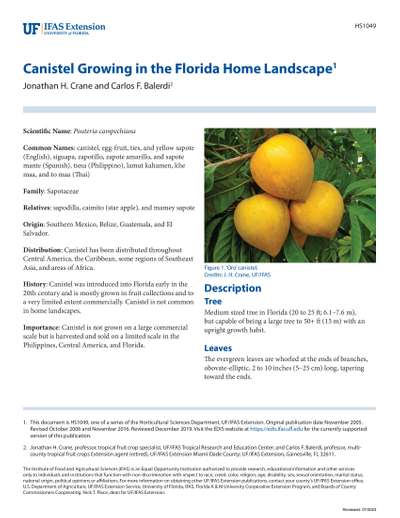
Canistel Growing in the Florida Home Landscape
Scientific Name: Pouteria campechiana
Common Names: canistel, egg-fruit, ties, and yellow sapote (English), siguapa, zapotillo, zapote amarillo, and sapote mante (Spanish), tiesa (Philippino), lamut kahamen, khe maa, and to maa (Thai)
Family: Sapotaceae Relatives: sapodilla, caimito (star apple), and mamey sapote
Origin: Southern Mexico, Belize, Guatemala, and El Salvador.
Distribution: Canistel has been distributed throughout Central America, the Caribbean, some regions of Southeast Asia, and areas of Africa.
History: Canistel was introduced into Florida early in the 20th century and is mostly grown in fruit collections and to a very limited extent commercially. Canistel is not common in home landscapes.
Importance: Canistel is not grown on a large commercial scale but is harvested and sold on a limited scale in the Philippines, Central America, and Florida.
1. This document is HS1049, one of a series of the Horticultural Sciences Department, UF/IFAS Extension. Original publication date November 2005. Revised October 2006 and November 2016. Reviewed December 2019. Visit the EDIS website at https://edis.ifas.ufl.edu for the currently supported version of this publication.
2. Jonathan H. Crane, professor, tropical fruit crop specialist, UF/IFAS Tropical Research and Education Center; and Carlos F. Balerdi, professor, multicounty tropical fruit crops Extension agent (retired), UF/IFAS Extension Miami-Dade County; UF/IFAS Extension, Gainesville, FL 32611.
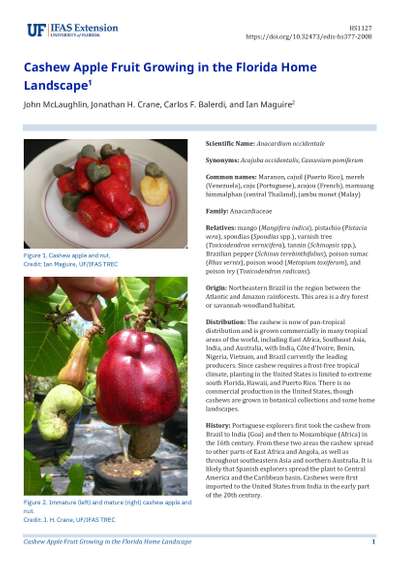
Cashew Apple Fruit Growing in the Florida Home Landscape
Scientific Name: Anacardium occidentale
Synonyms: Acajuba occidentalis, Cassuvium pomiferum
(Venezuela), caju (Portuguese), acajou (French), mamuang himmalphan (central Thailand), jambu monet (Malay)
Relatives: mango (Mangifera indica), pistachio (Pistacia vera), spondias (Spondias spp.), varnish tree (Toxicodendron vernicifera), tannin (Schinopsis spp.), Brazilian pepper (Schinus terebinthifolius), poison sumac (Rhus vernix), poison wood (Metopium toxiferum), and poison ivy (Toxicodendron radicans).
rigin: Northeastern Brazil in the region between the Atlantic and Amazon rainforests. This area is a dry forest or savannah-woodland habitat.
Distribution: The cashew is now of pan-tropical distribution and is grown commercially in many tropical areas of the world, including East Africa, Southeast Asia, India, and Australia, with India, Côte d'Ivoire, Benin, Nigeria, Vietnam, and Brazil currently the leading producers. Since cashew requires a frost-free tropical climate, planting in the United States is limited to extreme south Florida, Hawaii, and Puerto Rico. There is no commercial production in the United States, though cashews are grown in botanical collections and some home landscapes. History: Portuguese explorers first took the cashew from Brazil to India (Goa) and then to Mozambique (Africa) in the 16th century. From these two areas the cashew spread to other parts of East Africa and Angola, as well as throughout southeastern Asia and northern Australia. It is likely that Spanish explorers spread the plant to Central America and the Caribbean basin. Cashews were first imported to the United States from India in the early part of the 20th century.
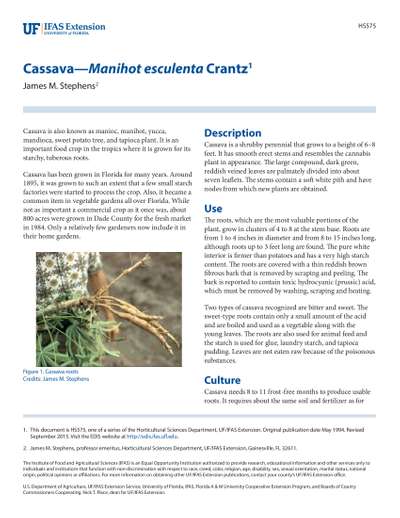
Cassava—Manihot esculenta Crantz
Cassava is also known as manioc, manihot, yucca, mandioca, sweet potato tree, and tapioca plant. It is an important food crop in the tropics where it is grown for its starchy, tuberous roots. Cassava has been grown in Florida for many years. Around 1895, it was grown to such an extent that a few small starch factories were started to process the crop. Also, it became a common item in vegetable gardens all over Florida. While not as important a commercial crop as it once was, about 800 acres were grown in Dade County for the fresh market in 1984. Only a relatively few gardeners now include it in their home gardens.
1. This document is HS575, one of a series of the Horticultural Sciences Department, UF/IFAS Extension. Original publication date May 1994. Revised September 2015. Visit the EDIS website at http://edis.ifas.ufl.edu.
2. James M. Stephens, professor emeritus, Horticultural Sciences Department, UF/IFAS Extension, Gainesville, FL 32611.
Chaya—Cnidoscolus chayamansa McVaugh
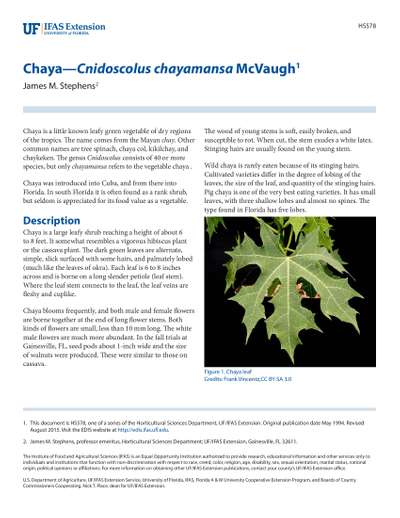
Chaya is a large leafy shrub reaching a height of about 6 to 8 feet. It somewhat resembles a vigorous hibiscus plant or the cassava plant. The dark green leaves are alternate, simple, slick surfaced with some hairs, and palmately lobed (much like the leaves of okra). Each leaf is 6 to 8 inches across and is borne on a long slender petiole (leaf stem). Where the leaf stem connects to the leaf, the leaf veins are fleshy and cuplike.
Chaya blooms frequently, and both male and female flowers are borne together at the end of long flower stems. Both kinds of flowers are small, less than 10 mm long. The white male flowers are much more abundant. In the fall trials at Gainesville, FL, seed pods about 1-inch wide and the size of walnuts were produced. These were similar to those on cassava.
1. This document is HS578, one of a series of the Horticultural Sciences Department, UF/IFAS Extension. Original publication date May 1994. Revised August 2015. Visit the EDIS website at http://edis.ifas.ufl.edu.
2. James M. Stephens, professor emeritus, Horticultural Sciences Department; UF/IFAS Extension, Gainesville, FL 32611.
Chayote—Sechium edule (Jacq.) Sw.
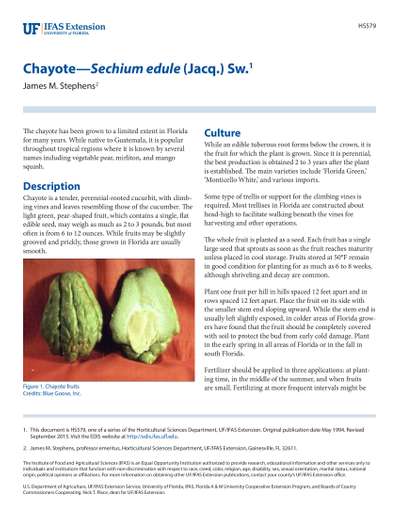
Chayote is a tender, perennial-rooted cucurbit, with climbing vines and leaves resembling those of the cucumber. The light green, pear-shaped fruit, which contains a single, flat edible seed, may weigh as much as 2 to 3 pounds, but most often is from 6 to 12 ounces. While fruits may be slightly grooved and prickly, those grown in Florida are usually smooth.
1. This document is HS579, one of a series of the Horticultural Sciences Department, UF/IFAS Extension. Original publication date May 1994. Revised September 2015. Visit the EDIS website at http://edis.ifas.ufl.edu.
2. James M. Stephens, professor emeritus, Horticultural Sciences Department, UF/IFAS Extension, Gainesville, FL 32611.
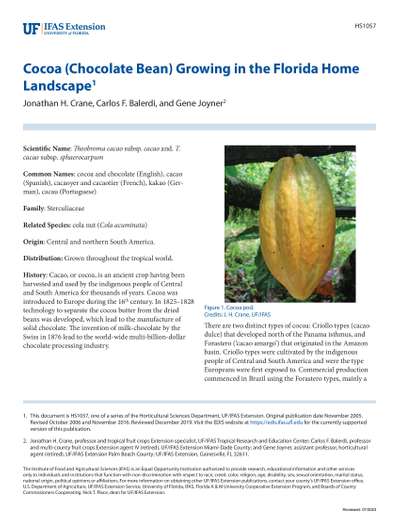
Cocoa (Chocolate Bean) Growing in the Florida Home Landscape
Scientific Name: Theobroma cacao subsp. cacao and. T. cacao subsp. sphaerocarpum
Common Names: cocoa and chocolate (English), cacao (Spanish), cacaoyer and cacaotier (French), kakao (German), cacau (Portuguese)
Family: Sterculiaceae Related Species: cola nut (Cola acuminata)
Origin: Central and northern South America.
Distribution: Grown throughout the tropical world.
History: Cacao, or cocoa, is an ancient crop having been harvested and used by the indigenous people of Central and South America for thousands of years. Cocoa was introduced to Europe during the 16th century. In 1825–1828 technology to separate the cocoa butter from the dried beans was developed, which lead to the manufacture of solid chocolate. The invention of milk-chocolate by the Swiss in 1876 lead to the world-wide multi-billion-dollar chocolate processing industry.