HS1477
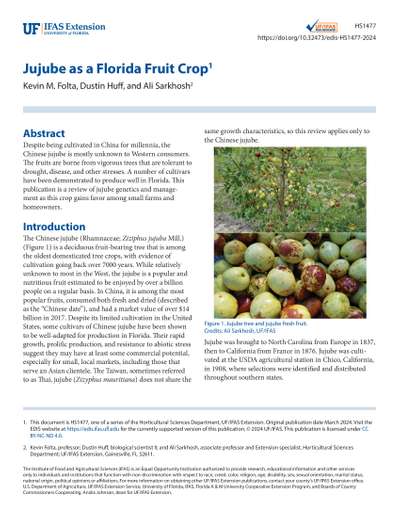
The Chinese jujube (Rhamnaceae; Ziziphus jujuba Mill.) (Figure 1) is a deciduous fruit-bearing tree that is among the oldest domesticated tree crops, with evidence of cultivation going back over 7000 years. While relatively unknown to most in the West, the jujube is a popular and nutritious fruit estimated to be enjoyed by over a billion people on a regular basis. In China, it is among the most popular fruits, consumed both fresh and dried (described as the “Chinese date”), and had a market value of over $14 billion in 2017. Despite its limited cultivation in the United States, some cultivars of Chinese jujube have been shown to be well-adapted for production in Florida. Their rapid growth, prolific production, and resistance to abiotic stress suggest they may have at least some commercial potential, especially for small, local markets, including those that serve an Asian clientele. The Taiwan, sometimes referred to as Thai, jujube (Zizyphus mauritiana) does not share the same growth characteristics, so this review applies only to the Chinese jujube. Jujube was brought to North Carolina from Europe in 1837, then to California from France in 1876. Jujube was cultivated at the USDA agricultural station in Chico, California, in 1908, where selections were identified and distributed throughout southern states.