Florida Nursery Plant Sheets
24 Issues in this Publication (Showing 11 - 20) Previous | Next
Giant Granadilla - Passiflora quadrangularis
Giant granadilla is a member of the Passiflora (Passionflower) family. Its botanical name is Passiflora quadrangularis.
Tropical climber. Saucer sized pink and purple fragrant flowers.
Giant granadilla grows as a perennial and is a flowering edible fruit. Being a perennial plant, it tends to grow best over several years (approx 3 years and greater).
Giant granadilla is known for its climber habit and growing to a height of approximately 12.00 metres (39.00 feet).
Otaheite Gooseberry - Phyllanthus acidus
Gooseberry is a shrub or tree growing anywhere from 5-30ft in height. Small white to slightly yellow colored fruit are borne in great abundance, with a crunchy, juicy, acidic flavored pulp.
Hardiness: The Otaheite Gooseberry is tropical or subtropical and can take several degrees of frost for brief periods of time.
Growing Environment: The trees generally prefer moist soil. There are often two fruiting cycles per year and depending on the climate, trees may produce off and on throughout the year.
Propagation: By seed, which may bear in 4 years, or by budding, greenwood cuttings, and air-layering.
Uses: Often the fruit is cooked with sugar, upon which the pulp and juice turns bright red. Common uses for the resulting fruit mixture are to prepare beverages or use as a sauce.
Native Range: Native to Madagascar, but was spread long ago by humans throughout much of India, southeast Asia, and some Pacific islands.
Guarana: Paullinia cupana
Description:
Evergreen rainforest vine (12-30 feet), native to the Amazon basin and found throughout Brazil.
White flowers are lightly scented throughout summer.
Medium growth rate. Can be grown in containers as pruned vine shrub.
Small round, red fruit with edible seeds. Fruits mature and dehisce the seeds in about 75 days. Common ingredients in energy drinks as the seeds contain 2x the caffine found in coffee beans.
Moringa Tree
Scientific Name: Moringa Oleifera
Hardiness Zone: Hardiness Zones 9 and 10 outdoors. With the right conditions, it can grow in Zone 8 as well.
Hazards: The roots of Moringa have the aroma of horseradish and should not be eaten, since they contain toxins
Description: Moringa is a resilient tree. It can survive in a variety of climates and substandard soils. It is as fast growing as it is hearty. Normal growth ranges from 3-5 meters per year if left uncropped. It is one of the fastest growing biomasses on the planet when properly nourished. A fully mature Moringa tree can grow to 35 feet. Moringa is an ideal plant to start indoors or, depending on where you live, or in your own backyard. Moringa seeds are about the size of a large pea and have wings. The seeds don‟t need sunlight in order to germinate.
Imbe - Garcinia livingstonei
Scientific Name: Garcinia livingstonei T. Anderson
Common Names: English (African mangosteen, wild plum, wild mangosteen, low veld mangosteen); Swahili (mutumbi,mpekechu)
Relatives: Cherapu, Garcinia prainiana; bakupari, G. brasiliensis; charchuela, G. macrophylla; Cuban mangosteen, G. aristata; madrono, G. madruno; mameyito, G. edulis
This small tree of east Africa bears an edible plum like fruit. Although the trees may reach a height of 15 to 20 feet, they are usually lower and have several trunks, which arch away from the main axis and produce a number of short, thick, side branches. The trees are often used as landscape subjects because of their unusual form.
Haitian Basket Vine - Trichostigma octandrum
Basket Vine, Trichostigma octandrum, a.k.a. Haitian basket vine, hoop vine, liann panye (in Haiti) grows as a large perennial, sprawling bush. It is considered a native species in South Florida and on many of the Caribbean islands. It was formerly placed in the pokeweed family.. It is known in English as hoopvine] (Florida), black basket wythe, cooper's wythe, basket wiss or basket with, and hoop with. Common French names include liane pannier or liane a barques ('basket vine' or 'barrel vine'). Spanish names include bejuco canesta, sotacaballo, and pabello, (Puerto Rico, Central America, basket vine, substitute horse, or pavilion). The plant has medicinal and fiber uses.
Jabuticaba - Plinia cauliflora
Common Names: Jaboticaba, Jabuticaba, Guaperu, Guapuru, Hivapuru, Sabara, Ybapuru
Species: Myrciaria cauliflora Berg., M. jaboticaba Berg., M. tenella Berg., M. trunciflora Berg.
Related Species: Guavaberry, Rumberry (Myrciaria floribunda), Yellow Jaboticaba (M. glomerata), Camu-camu (M. paraensis). Blue Grape (M. vexator).
Distant affinity: Eugenias (Eugenia spp.), Feijoa (Feijoa sellowiana), Guavas (Psidium spp.).
Origin: All four of the jaboticaba species are native to the Minas Gerais region of Brazil. Some are also indigenous to other parts of Brazil, as well as areas in Bolivia, Paraguay, northeastern Argentina, Uruguay and Peru. In Brazil jaboticabas are cultivated from the southern city of Rio Grande to Bahia, and from the seacoast to Goyaz and Matto Grosso in the west. It was introduced into California (at Santa Barbara) about 1904.
Adaptation: Jaboticaba's adapt well to both tropical and subtropical climates, surviving temperatures as low as 22-27F even when young. In Brazil jaboticabas grow from sea-level to elevations of more than 3,000 ft. Different plants vary markedly in how much frost they can take without severe damage, probably reflecting the species that a given plant belongs to. Some plants can take 24° F or lower and survive; others are damaged at 27° F. In 1917, a young tree at Brooksville, Florida survived a temperature drop to 18° F. with only the foliage and branches killed back. In California jaboticabas have been successfully grown in San Diego, Spring Valley, Bostonia, Encinitas, South Los Angeles and as far north as the San Jose and San Francisco Bay areas. The plant makes a suitable container specimen. The tree is small enough fit into many parts of the garden landscape.
Jamaican Mint Tree
Scientific Name: Clinopodium vimineum
Common Names: Satureja viminea, Kama Sutra Mint Tree, Jamacian Mint Bush
Size: H 6-10 ft, W 3-6 ft
Hardiness Zones:
USDA Zone 10a: to -1.1 °C (30 °F)
USDA Zone 10b: to 1.7 °C (35 °F)
USDA Zone 11: above 4.5 °C (40 °F)
Hazards: None
Propagation: Seed
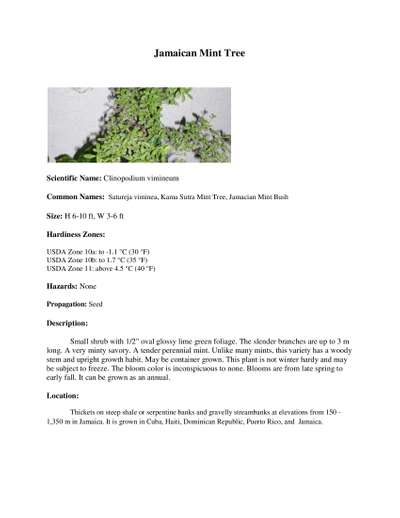
Description: Small shrub with 1/2" oval glossy lime green foliage. The slender branches are up to 3 m long. A very minty savory. A tender perennial mint. Unlike many mints, this variety has a woody stem and upright growth habit. May be container grown. This plant is not winter hardy and may be subject to freeze. The bloom color is inconspicuous to none. Blooms are from late spring to early fall. It can be grown as an annual.
Cultivation of Pepper
Pepper is a tropical plant that grows in hot humid areas with a high rainfall. Locally it can only be grown in the Lowveld and along the northern coastal areas of KwaZulu-Natal.
Botanical characteristics
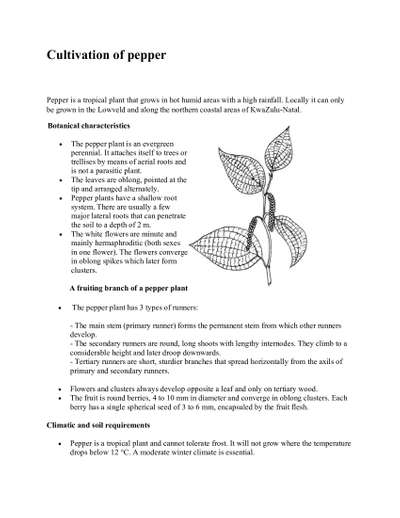
- The pepper plant is an evergreen perennial. It attaches itself to trees or trellises by means of aerial roots and is not a parasitic plant.
- The leaves are oblong, pointed at the tip and arranged alternately.
- Pepper plants have a shallow root system. There are usually a few major lateral roots that can penetrate the soil to a depth of 2 m.
- The white flowers are minute and mainly hermaphroditic (both sexes in one flower). The flowers converge in oblong spikes which later form clusters.
Pineapple Verbena
Scientific Name: Nashia inaguensis Millsp. el tuque
Family: Verbenaceae
Common names: Moujean tea, pineapple verbena.
Duration: Perennial Shrub Range: Caribbean - Bahamas. Scrublands
Height: 2 meters
Medicinal uses: None known Propagation: Seed, cuttings (spring and early summer with warm nights)
Hardiness zones: Zone 9b
Pests: Pit scale and mealy bugs, especially indoors or in areas with poor air circulation
Description: Moujean tea is a small, perennial, evergreen, shrub with long arching stems. The mature trunk is 3-4 inches.The leaves are very small, between 1/4′′-1/2′′ long, glossy, have a wrinkled surface texture, are covered in tiny hairs, and release a strong aroma of citrus/honey/vanilla when crushed. The inconspicuous, white, intensely fragrant, flowers, form in clusters at the leaf nodes. The white flowers are tiny and form in clusters. They have an intense fragrance of jasmine. The berries are reddish orange that are 1/2 in long beads. This shrub attracts bees, butterflies and bugs and is a host for the Atala butterfly.