The University of Florida (UF) provides numerous plant information PDFs through its IFAS Extension and the Florida-Friendly Landscaping program. Key publications include the Florida-Friendly Landscaping™ Guide to Plant Selection & Landscape Design and guides on low-maintenance and regionally specific plants, such as the one for south Florida. Other PDFs cover specific topics like vegetable production, tree fact sheets on planting and pruning, and invasive species information.
69 Issues in this Publication (Showing issues - 1) Previous
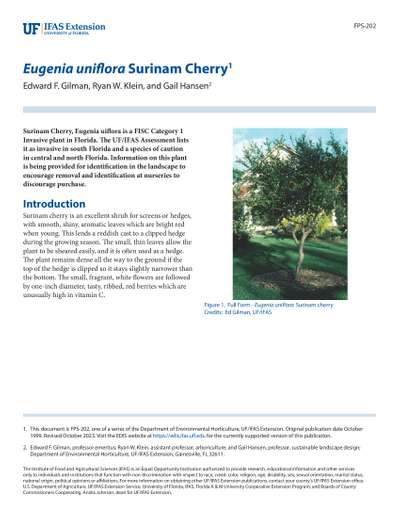
Eugenia uniflora Surinam Cherry
FPS-202
Scientific name: Eugenia uniflora
Pronunciation: yoo-JEE-nee-uh yoo-nif-FLOR-uh
Common name(s): Surinam cherry
Family: Myrtaceae Plant type: tree
USDA hardiness zones: 9B through 11 (Figure 5)
Planting month for zone 9: year round Planting month for zone 10 and 11: year round
Origin: native to South America Invasive potential: Invasive and not recommended by UF/ IFAS faculty (reassess in 10 years)
Uses: fruit; superior hedge; container or above-ground planter; trained as a standard; recommended for buffer strips around parking lots or for median strip plantings in the highway; border
Availability: generally available in many areas within its hardiness range
Japanese Persimmon Cultivars in Florida
SP101
Japanese persimmons, Diospyros kaki L., originated in China and were frst grown in Florida in the 1870s. At one time, there were commercial plantings of astringent types, numbering about 22,750 trees. Because of marketing difculties, this industry ceased. California is the largest producer of Japanese persimmons, followed by Florida and southern Texas. According to the 2017 Census of Agriculture data for all persimmons in the United States, most plantings are on a small scale. Of the nearly 2,400 farms growing the fruit, about 70% have less than 1 acre, and 90% have less than 5 acres. Current acreage in Florida is estimated to be 266 acres as of 2017, down from 324 in 2012 and from the estimated high of 500 acres in the mid-1990s. However, the number of farms in Florida growing the fruit has increased from 164 to 227 during the 2012 to 2017 period, further emphasizing the small-scale nature of average acreage of persimmons per farm. Trees grow and fruit best in central and northern Florida and can produce high yields of good-quality fruit. In south Florida, fruit quality is better with astringent types than with nonastringent types.
1. This document is SP101, one of a series of the Horticultural Sciences Department, UF/IFAS Extension. Original publication date April 1994. Revised February 2020. Visit the EDIS website at https://edis.ifas.uf.edu for the currently supported version of this publication. This is a major revision of Oriental Persimmons in Florida by E. P. Miller and T. E. Crocker, available at https://ufdc.uf.edu/IR00005924/00001.
2. Ali Sarkhosh, assistant professor and Extension specialist, Horticultural Sciences Department; Peter C. Andersen, professor emeritus, Horticultural Sciences Department, UF/IFAS North Florida Research and Education Center; and Dustin Huf, biological scientist, Horticultural Sciences Department; UF/IFAS Extension, Gainesville, FL 32611.
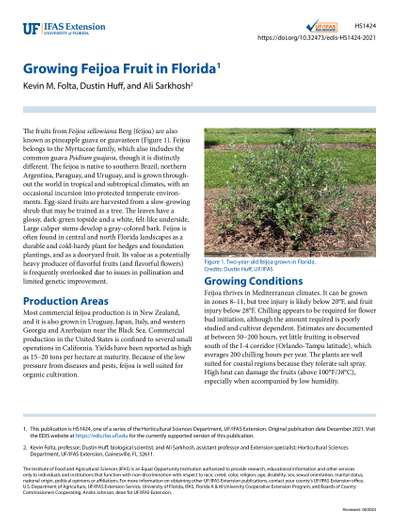
Growing Feijoa Fruit in Florida
HS1424
Te fruits from Feijoa sellowiana Berg (feijoa) are also known as pineapple guava or guavasteen (Figure 1). Feijoa belongs to the Myrtaceae family, which also includes the common guava Psidium guajava, though it is distinctly diferent. Te feijoa is native to southern Brazil, northern Argentina, Paraguay, and Uruguay, and is grown throughout the world in tropical and subtropical climates, with an occasional incursion into protected temperate environments. Egg-sized fruits are harvested from a slow-growing shrub that may be trained as a tree. Te leaves have a glossy, dark-green topside and a white, felt-like underside. Large caliper stems develop a gray-colored bark. Feijoa is ofen found in central and north Florida landscapes as a durable and cold-hardy plant for hedges and foundation plantings, and as a dooryard fruit. Its value as a potentially heavy producer of favorful fruits (and favorful fowers) is frequently overlooked due to issues in pollination and limited genetic improvement.
1. This publication is HS1424, one of a series of the Horticultural Sciences Department, UF/IFAS Extension. Original publication date December 2021. Visit the EDIS website at https://edis.ifas.uf.edu for the currently supported version of this publication.
2. Kevin Folta, professor; Dustin Huf, biological scientist; and Ali Sarkhosh, assistant professor and Extension specialist; Horticultural Sciences Department, UF/IFAS Extension, Gainesville, FL 32611.
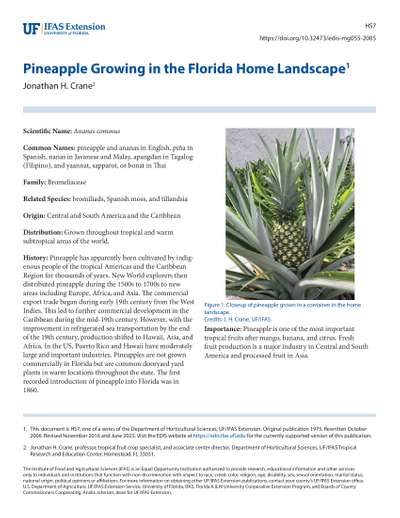
Pineapple Growing in the Florida Home Landscape
HS7
Scientific Name: Ananas comosus
Common Names: pineapple and ananas in English, piña in Spanish, nanas in Javanese and Malay, apangdan in Tagalog (Filipino), and yaannat, sapparot, or bonat in Thai
Family: Bromeliaceae
Related Species: bromiliads, Spanish moss, and tillandsia
Origin: Central and South America and the Caribbean
Distribution: Grown throughout tropical and warm subtropical areas of the world.
History: Pineapple has apparently been cultivated by indigenous people of the tropical Americas and the Caribbean Region for thousands of years. New World explorers then distributed pineapple during the 1500s to 1700s to new areas including Europe, Africa, and Asia. The commercial export trade began during early 19th century from the West Indies. This led to further commercial development in the Caribbean during the mid-19th century. However, with the improvement in refrigerated sea transportation by the end of the 19th century, production shifted to Hawaii, Asia, and Africa. In the US, Puerto Rico and Hawaii have moderately large and important industries. Pineapples are not grown commercially in Florida but are common dooryard yard plants in warm locations throughout the state. The first recorded introduction of pineapple into Florida was in 1860.
Roselle—Hibiscus sabdariffa L.
HS659
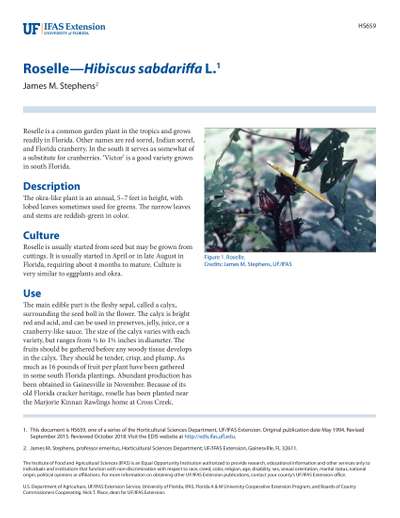
Roselle is a common garden plant in the tropics and grows readily in Florida. Other names are red sorrel, Indian sorrel, and Florida cranberry. In the south it serves as somewhat of a substitute for cranberries. ‘Victor’ is a good variety grown in south Florida.
Description
The okra-like plant is an annual, 5–7 feet in height, with lobed leaves sometimes used for greens. The narrow leaves and stems are reddish-green in color.
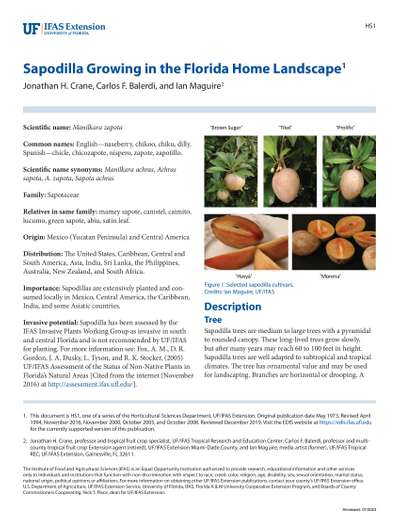
Sapodilla Growing in the Florida Home Landscape
HS1
Scientific name: Manilkara zapota
Common names: English—naseberry, chikoo, chiku, dilly. Spanish—chicle, chicozapote, níspero, zapote, zapotillo.
Scientific name synonyms: Manilkara achras, Achras sapota, A. zapota, Sapota achras
Family: Sapotaceae
Relatives in same family: mamey sapote, canistel, caimito, lucumo, green sapote, abiu, satin leaf.
Origin: Mexico (Yucatan Peninsula) and Central America
Distribution: The United States, Caribbean, Central and South America, Asia, India, Sri Lanka, the Philippines, Australia, New Zealand, and South Africa.
Importance: Sapodillas are extensively planted and consumed locally in Mexico, Central America, the Caribbean, India, and some Asiatic countries.
Invasive potential: Sapodilla has been assessed by the IFAS Invasive Plants Working Group as invasive in south and central Florida and is not recommended by UF/IFAS for planting. For more information see: Fox, A. M., D. R. Gordon, J. A. Dusky, L. Tyson, and R. K. Stocker, (2005) UF/IFAS Assessment of the Status of Non-Native Plants in Florida’s Natural Areas [Cited from the internet (November 2016) at http://assessment.ifas.ufl.edu/].
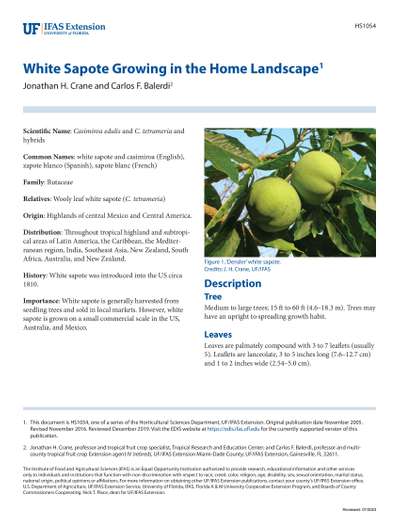
White Sapote Growing in the Home Landscape
HS1054
Scientific Name: Casimiroa edulis and C. tetrameria and hybrids
Common Names: white sapote and casimiroa (English), zapote blanco (Spanish), sapote blanc (French)
Family: Rutaceae Relatives: Wooly leaf white sapote (C. tetrameria) Origin: Highlands of central Mexico and Central America.
Distribution: Throughout tropical highland and subtropical areas of Latin America, the Caribbean, the Mediterranean region, India, Southeast Asia, New Zealand, South Africa, Australia, and New Zealand.
History: White sapote was introduced into the US circa 1810.
Importance: White sapote is generally harvested from seedling trees and sold in local markets. However, white sapote is grown on a small commercial scale in the US, Australia, and Mexico.
1. This document is HS1054, one of a series of the Horticultural Sciences Department, UF/IFAS Extension. Original publication date November 2005. Revised November 2016. Reviewed December 2019. Visit the EDIS website at https://edis.ifas.ufl.edu for the currently supported version of this publication.
2. Jonathan H. Crane, professor and tropical fruit crop specialist, Tropical Research and Education Center; and Carlos F. Balerdi, professor and multi-county tropical fruit crop Extension agent IV (retired), UF/IFAS Extension Miami-Dade County; UF/IFAS Extension, Gainesville, FL 32611.
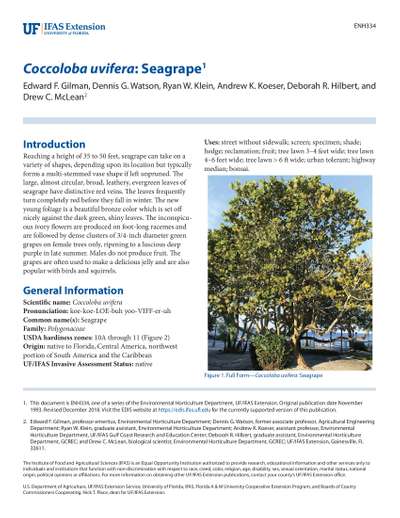
Coccoloba uvifera: Seagrape
ENH334
Scientific name: Coccoloba uvifera
Pronunciation: koe-koe-LOE-buh yoo-VIFF-er-uh
Common name(s): Seagrape
Family: Polygonaceae
USDA hardiness zones: 10A through 11 (Figure 2)
Origin: native to Florida, Central America, northwest portion of South America and the Caribbean UF/IFAS Invasive Assessment
Status: native
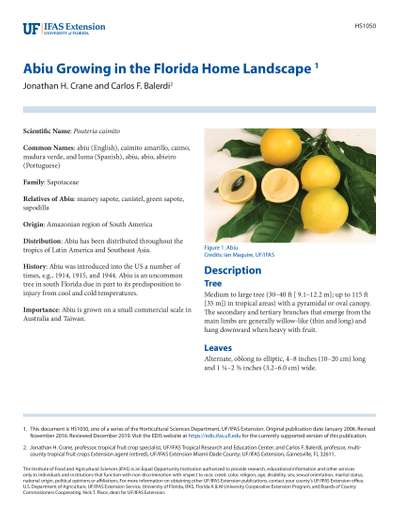
Abiu Growing in the Florida Home Landscape
HS1050
Scientific Name: Pouteria caimito
Common Names: abiu (English), caimito amarillo, caimo, madura verde, and luma (Spanish), abiu, abio, abieiro (Portuguese)
Family: Sapotaceae
Relatives of Abiu: mamey sapote, canistel, green sapote, sapodilla
Origin: Amazonian region of South America
Distribution: Abiu has been distributed throughout the tropics of Latin America and Southeast Asia.
1. This document is HS1050, one of a series of the Horticultural Sciences Department, UF/IFAS Extension. Original publication date January 2006. Revised November 2016. Reviewed December 2019. Visit the EDIS website at https://edis.ifas.ufl.edu for the currently supported version of this publication.
2. Jonathan H. Crane, professor, tropical fruit crop specialist, UF/IFAS Tropical Research and Education Center; and Carlos F. Balerdi, professor, multicounty tropical fruit crops Extension agent (retired), UF/IFAS Extension Miami-Dade County; UF/IFAS Extension, Gainesville, FL 32611.